

Get the latest research to your inbox
- 5 Jun 2025Please join us for the June session of the IMB Lecture Series featuring Professor Marc Pellegrini.
- Associate Scientific AssistantInstitute for Molecular Bioscience
Senior Leadership Team
Professor Ian Henderson
Institute DirectorInstitute for Molecular BioscienceResearcher profile is public:1Supervisor:Body:Professor Ian Henderson is the Executive Director of the Institute for Molecular Bioscience at The University of Queensland. In this role, he is responsible for developing the research strategy of an established, world-leading research institute with over 500 staff and students, fostering collaboration and raising the profile of the Institute and University internationally.
Prior to becoming Executive Director, he was Deputy Director (Research) at IMB. Professor Henderson was previously the Director of the Institute of Microbiology and Infection at University of Birmingham from 2015-2018.
He is a Professor of Microbial Biology who completed his Bachelor of Science (Hons) at University College Dublin and his PhD at Trinity College Dublin. He also holds a Postgraduate Certificate in Teaching and Learning in Higher Education from The University of Birmingham. Professor Henderson is a Fellow of the Royal Society of Biology.
Professor Henderson's research interests focus on the cell surface of bacteria. This focus is based on the philosophy that the bacterial cell surface offers a rich source of molecules, which can be utilised and adapted to diagnose, prevent or treat infections that can lead to life-threatening disease in humans and animals.
His research group has three major themes exploiting a range of experimental techniques to address fundamental questions in the biology of host-pathogen interactions:
(1) Using biochemical and biophysical methodologies to study protein secretion in Gram negative bacteria
(2) using molecular biology, cellular biology and immunological methodologies to study the roles outer membrane proteins play in the interaction of pathogens with their hosts
(3) using genetic, structural, biochemical and biophysical techniques to understand the molecular basis for the integrity of the Gram-negative outer membrane.Professor Henderson has published over 150 research papers, reviews and book chapters. He has an H-index of 62, and his publications have been cited over 15,000 times, with an average of 100 citations per paper.
Mrs Lisa Cornish
Director, Institute OperationsInstitute for Molecular BioscienceResearcher profile is public:0Supervisor:Professor Mark Blaskovich
Director of Translation & Professorial Research Fellow & Group LeaderInstitute for Molecular BioscienceResearcher profile is public:1Supervisor:Researcher biography:Professor Mark Blaskovich is an antibiotic hunter and Director of Translation at the Institute for Molecular Bioscience at The University of Queensland. He is co-founder and former Director of the Centre for Superbug Solutions at IMB.
A medicinal chemist with 15 years of industrial drug development experience prior to his academic career, Mark has been developing new antibiotics to treat drug resistant pathogens and using modified antibiotics to detect bacterial infections. He is a co-founder of the Community for Open Antimicrobial Drug Discovery, a global antibiotic discovery initiative, and has led a number of UQ-industry collaborations focused on antibiotic development. An inventor on eleven patent families, Mark has developed drugs in clinical trials, published more than eighty research articles, and received over $10m in grant funding.
Professor Irina Vetter
Director for Higher Degree Research & NHMRC Leadership Fellow & Group LeaderInstitute for Molecular BioscienceResearcher profile is public:1Supervisor:Researcher biography:I am an NHMRC Leadership Fellow with joint apointments at the Institute for Molecular Bioscience (IMB) and School of Pharmacy, UQ. My research interests lie in the fields of peripheral pain mechanisms, target identification and analgesic drug discovery. I investigate the contribution of ion channels to sensory neuronal physiology using highly subtype-selective toxins isolated from venomous animals with the aim to develop novel analgesics with improved efficacy and tolerability.
Body:Highlights
Associate Professor Irina Vetter has a strong background in neuropharmacology, pain models, toxinology and high-throughput screening. Currently her primary research interests lie in the fields of peripheral pain mechanisms, target identification, biodiscovery of venom peptide ion channel modulators and analgesic drug discovery.
Associate Professor Vetter has always been fascinated by how we perceive the world around us, in particular, the role of sensory neurons in the body. Sensory neurons are an intricate network of nerve cells that convert external stimuli from the environment into messages within the body, like pain. Her research is demystifying the different pathways that contribute to pain in various disease states. She is using biomedical research and pharmacology to develop pain treatments from venoms and toxins.
Associate Professor Vetter is an ARC Future Fellow and Deputy Director of the Centre for Pain Research at The University of Queensland. She is a registered pharmacist and has worked in hospital as well as community pharmacy. She obtained her PhD in 2007 from the School of Pharmacy, and conducted postdoctoral studies as an NHMRC postdoctoral fellow under Prof Geoffrey Goodhill at the Queensland Brain Institute and under Prof Richard J Lewis at the Institute for Molecular Bioscience in the areas of axon guidance and venom peptide pharmacology
Video
Connect


- We need effective antibiotics more than ever, but a broken market has slowed down discovery.
- Research Project CoordinatorInstitute for Molecular Bioscience
- PhD studentInstitute for Molecular Bioscience
- PhD studentInstitute for Molecular Bioscience
Pages
Strawberry DNA extraction activity
Extract and view DNA from a strawberry using common household ingredients.
Get started
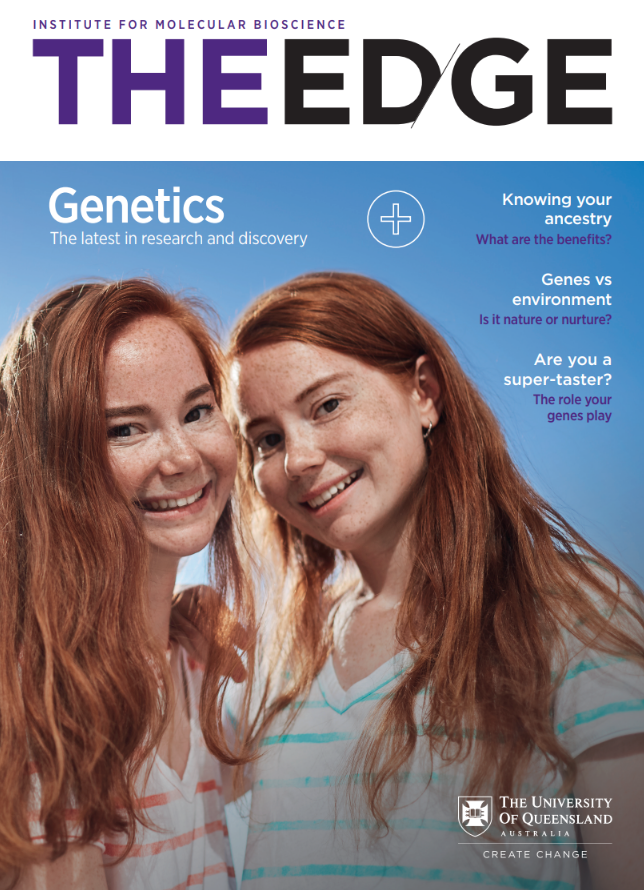
The Edge: Genetics
People have known for thousands of years that parents pass traits to their children, but it is only relatively recently that our technology has caught up to our curiosity, enabling us to delve into the mystery of how this inheritance occurs, and the implications for predicting, preventing and treating disease.
Subscribe to our newsletter
Get the latest research straight to your inbox.
Stay up-to-date as we answer questions about hot topics, and share the latest news at IMB, Australia’s #1 research institute.
General enquiries
+61 7 3346 2222
imb@imb.uq.edu.au
Media enquiries
IMB fully supports UQ's Reconciliation Action Plan and is implementing actions within our institute.
Support us
Donate to research
100% of donations go to the cause