
Get the latest research to your inbox
Cater Lab Team
Group Leader
Dr Rosemary Cater
Senior Research Fellow & Group LeaderInstitute for Molecular BioscienceResearcher profile is public:1Supervisor:Researcher biography:Dr. Rosemary Cater is a Senior Research Fellow and Group Leader at the University of Queensland's Institute for Molecular Bioscience in Australia. She fulfilled her Ph.D. under the supervision of Prof. Renae Ryan at the University of Sydney, where she used electrophysiology and x-ray protein crystallography to understand how glutamate transporters serve a secondary function as chloride channels. She then went on to complete her post-doctoral training in the lab of Prof. Filippo Mancia at Columbia University, where she used single-particle cryo-electron microscopy and antigen-binding technology to determine structures of small membrane proteins. The overarching goal of the Cater Lab is to understand the molecular mechanisms of nutrient transport at the blood-brain barrier, and how variations to this are implicated in different diseases states.
Dr Cater is a current ARC DECRA Fellow, and has received several prestigious awards and fellowships, for her research including the New York Academy of Sciences Blavatnik Regional Award (2022) and the Eppendorf & Science Journal Award for Neurobiology (2024).
Researchers
Dr Farrah Blades
Postdoctoral Research FellowInstitute for Molecular BioscienceResearcher profile is public:1Supervisor:Researcher biography:My research interests are in cell structure, intra-cellular pathways and in protein structure. During my honors I characterised two mouse models of Multiple Sclerosis, looking at T-cell permeability through the blood-brain barrier and the CXCR4/ CXCL12 chemokine axis. During my PhD I found critical roles for the tyrosine kinase receptor, Tyro3, in myelination and retinal ganglion cell function while assessing the neuronal functional outcomes of Tyro3 driven myelin structural deficits. Following my PhD, I moved to the university of Queensland to begin a post doctoral research fellowship under the supervision of Prof. Ben Hankamer, where I focussed on cryogenic electron microscopy and single particle analysis of the photosystem II supercomplex. During this time I also helped establish a virtual desktop which runs from the Bunya supercomputer, making research software accessible and easier to use across UQ.
As of 2024 I have begun as a post doctoral research fellow under the supervision of Dr. Rosemary Cater, I will be assessing the structure and function of membrane transporter proteins such as FLVCR2 and MFSD2A in the context of the blood-brain and blood-retinal barrier. Our goal is twofold: first, to comprehend the fundamental biology of these transporters; second, to discover a mechanism that enables drug access across the blood-brain and blood-retinal barriers. This advancement will facilitate therapeutic treatments for an array of central nervous system diseases.
Body:Dr Farrah Blade's research interests are in cell structure, intra-cellular pathways and in protein structure. During her honours she characterised two mouse models of Multiple Sclerosis, looking at T-cell permeability through the blood-brain barrier and the CXCR4/ CXCL12 chemokine axis.
During her PhD, Farrah found critical roles for the tyrosine kinase receptor, Tyro3, in myelination and retinal ganglion cell function while assessing the neuronal functional outcomes of Tyro3 driven myelin structural deficits.
Following her PhD, Farrah moved to The University of Queensland (UQ) to begin a Post Doctoral Research Fellowship under the supervision of Professor Ben Hankamer, where she focused on cryogenic electron microscopy and single particle analysis of the photosystem II supercomplex. During this time she also helped establish a virtual desktop which runs from the Bunya supercomputer, making research software accessible and easier to use across UQ.As of 2024, Farrah has begun a post doctoral research position under the supervision of Dr Rosemary Cater, assessing the structure and function of membrane transporter proteins such as FLVCR2 and MFSD2A in the context of the blood-brain and blood-retinal barrier. The goal is twofold: first, to comprehend the fundamental biology of these transporters; second, to discover a mechanism that enables drug access across the blood-brain and blood-retinal barriers. This advancement will facilitate therapeutic treatments for an array of central nervous system diseases.
Students
Mr Matthew van der Burg
PhD StudentInstitute for Molecular BioscienceResearcher profile is public:0Supervisor:Ms Ariana Ivanic
PhD StudentInstitute for Molecular BioscienceResearcher profile is public:0Supervisor:Miss Ruohua Gao
PhD StudentInstitute for Molecular BioscienceResearcher profile is public:0Supervisor:Mr Parteek Mandhan
StudentInstitute for Molecular BioscienceResearcher profile is public:1Supervisor:- Honorary Fellow/Associate LecturerInstitute for Molecular Bioscience
- Honours studentInstitute for Molecular Bioscience
- PhD studentInstitute for Molecular Bioscience
Montgomery Group
Group Leader
Professor Grant Montgomery
Emeritus ProfessorInstitute for Molecular BioscienceResearcher profile is public:0Supervisor:Body:Highlights
Professor Grant Montgomery uses genetic approaches to discover critical genes and pathways increasing risk for reproductive disorders. He applies state of the art genomic techniques to identify risk factors and understand how these genetic differences regulate gene expression and epigenetics to alter disease risk. The goal is to understand disease biology and help develop better methods for diagnosis and treatment.
A major focus is women’s health and the pathogenesis of endometriosis. Together with colleagues in Brisbane, he led a recent large international study on genetic risk factors for endometriosis which confirmed 14 regions of the genome are associated with the disease, including 5 novel regions. His research is now moving to functional studies to identify the target genes in each region and determine how changes in the regulation of these genes contribute to disease. Professor Montgomery has published the first examples of likely target genes for two regions.
He is also using genomic approaches to help understand environmental risk factors for this disease. Environmental risk factors may leave epigenetic signals on DNA that are associated with disease and he is part of an international study on global methylation analysis in endometriosis.
Video
Connect


Researchers
Dr Sugarniya Subramaniam
Research AssistantInstitute for Molecular BioscienceResearcher profile is public:0Supervisor:Dr Brett McKinnon
Senior Research FellowInstitute for Molecular BioscienceResearcher profile is public:1Supervisor:Researcher biography:I am a basic science researcher with training in cell biology, genetics and research translation. My research investigates the female reproductive system by focusing on the contribution of individual cells. I aim to understand the influence of genetic architecture, differentiation and maturation on these individual cells and how this contributes to changes in the microenvironment that can contribute to disease initiation and progression.
After the completion of my PhD in 2008 at the University of Queensland, I undertook post-doctoral studies at the University of Bern, Department of Biomedical Research (DBMR), focusing on endometriosis, ovarian and endometrial cancer. I curated patient samples from clinical research trials to investigate inflammatory and metabolic components of reproductive tissue and disease and began developing patient-derived models of the endometrium. I established a relationship between endometriosis lesions, nerves and pain and how this interaction was mediated by inflammation. I further developed patient-derived in vitro models to understand the interaction between inflammation and hormonal response of endometriotic lesions and how this could be utilized to target current and novel treatments. On returning to Australia in 2016 I joined the Genomics of Reproductive Disorders laboratory to integrate genetic background into patient-derived in vitro models. I established the Endometriosis Research Queensland Study (ERQS) in collaboration with the Royal Brisbane and Women's Hospital (RBWH) and extended in vitro models into complex multi-cellular assembloids (combinations of organoids and surrounding stromal cells).
Mr Sharat Atluri
Researcher profile is public:0Supervisor:Dr Sam Lukowski
Researcher profile is public:0Supervisor:Students
Mr Isaac Kyei Barffour
Researcher profile is public:0Supervisor:Miss Isabelle McGrath
PhD studentInstitute for Molecular BioscienceResearcher profile is public:0Supervisor:Miss Li Ying Thong
PhD studentInstitute for Molecular BioscienceResearcher profile is public:0Supervisor:Mr Kei Tanaka
PhD studentInstitute for Molecular BioscienceResearcher profile is public:1Supervisor:- To develop new methodologies in machine learning and artificial intelligence to generate useful predictive mathematical models
- 23 Mar 2024IMB Group Leader, Professor John Fraser joins Dr Iris Depaz, Professor Alan Rowan and Professor Avril Robertson in conversation about how biotechnology is transforming the world of medicine.
Pages
Strawberry DNA extraction activity
Extract and view DNA from a strawberry using common household ingredients.
Get started
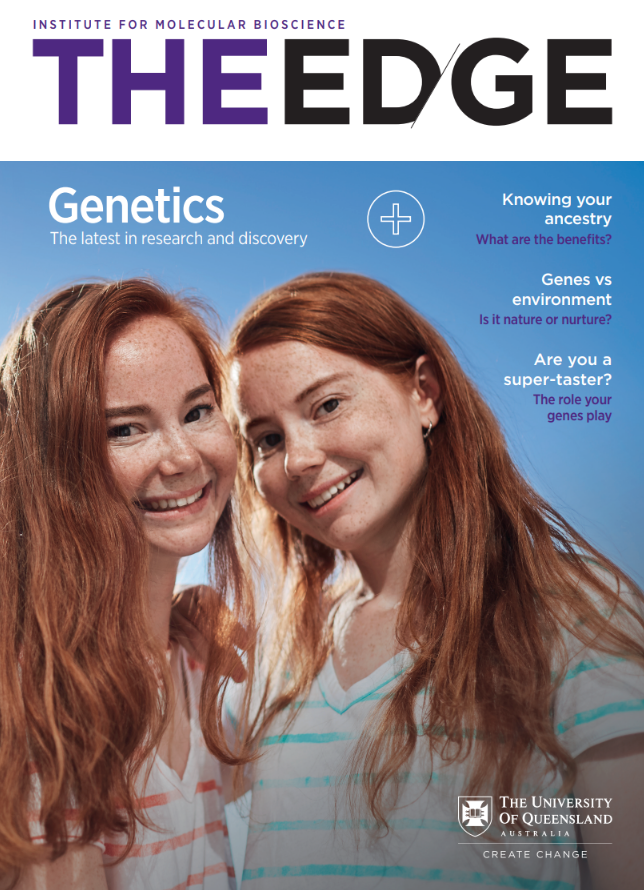
The Edge: Genetics
People have known for thousands of years that parents pass traits to their children, but it is only relatively recently that our technology has caught up to our curiosity, enabling us to delve into the mystery of how this inheritance occurs, and the implications for predicting, preventing and treating disease.
Subscribe to our newsletter
Get the latest research straight to your inbox.
Stay up-to-date as we answer questions about hot topics, and share the latest news at IMB, Australia’s #1 research institute.
General enquiries
+61 7 3346 2222
imb@imb.uq.edu.au
Media enquiries
IMB fully supports UQ's Reconciliation Action Plan and is implementing actions within our institute.

Support us
Donate to research
100% of donations go to the cause


