

Get the latest research to your inbox
- PhD studentInstitute for Molecular Bioscience
Schembri group
Group Leader
Professor Mark Schembri
Centre Director of Institute for Molecular Bioscience & Professorial Research Fellow & Group LeaderInstitute for Molecular BioscienceResearcher profile is public:1Supervisor:Researcher biography:Professor Mark Schembri is a prominent microbiologist with experience in combating the global health crisis presented by multi-drug resistant pathogens. Professor Schembri's expertise on the virulence of bacterial pathogens and his innovative analysis of biofilm formation aims to improve the outcomes of the >400 million individuals that suffer from urinary tract infections each year across the globe.
Through the application of genetic, genomic and functional studies on uropathogenic E. coli, Professor Schembri has identified targets to reduce the virulence of this pathogen, and will pursue the development of life-saving therapeutic and preventative advances with the assistance of NHMRC, MRFF and ARC grants. Professor Schembri has tracked the rapid emergence and global spread of a virulent, drug-resistant E. coli clone and used genome sequencing to understand its evolution and virulence.
Links: Professor Schembri collaborates with national and international research leaders, including in Denmark, where he was a lecturer. Professor Schembri has strong links with other international experts in his field, including at the Pasteur Institute and the Wellcome Trust Sanger Institute in Cambridge. His research collaborations also span lead groups at UQ and other top Australian institutes, including Griffith and La Trobe Universities.
Membership, Funding and patents: Since 2014, Professor Schembri has been awarded over $15 million in funding from competitive national research funding bodies. He holds provisional patents for the development of novel therapeutic agents and vaccine antigens. He is a Fellow of the American Academy of Microbiology, and is regularly invited to speak at international conferences in his field.
Awards and Communication: Professor Schembri was the recipient of the Frank Fenner Award (2010) and the ASM BacPath Oration Award (2019) for his outstanding original research contribution to the study of Infectious Disease. He was an Australian Research Council Future Fellow (2011-2015) a National Health and Medical Research Council Senior Research Fellow (2016-2020). Professor Schembri is the author of >240 peer-reviewed research manuscripts. He is President of the Australian Society for Microbiology (2022-2026).
Researchers
Dr Duy Phan
Research FellowInstitute for Molecular BioscienceResearcher profile is public:1Supervisor:Researcher biography:I got my BSc degree from the University of Natural Sciences in Vietnam. I spent the next two years working on characterisation of multi-drug resistant Mycobacterium tuberculosis with Dr Maxine Caws at the Oxford University Clinical Research Unit in Ho Chi Minh City, Vietnam. I went to the Wellcome Trust Sanger Institute and the University of Cambridge, UK to do my PhD in Prof. John Wain lab where I studied molecular mechanisms affecting the stability of IncHI1 multidrug resistant plasmids in Salmonella Typhi. I then moved to Australia to join the group of Prof. Mark Schembri at the School of Chemistry and Molecular Biosciences, University of Queensland. I am now working on identifying novel virulent factors in uropathogenic E. coli, especially in the newly emerged but globally spread ST131 clone, using high-throughput transposon mutagenesis and next-gen sequencing. I also maintain my interest in plasmid biology and have started projects to study multidrug resistant plasmids carrying blaCTX-M-15 or blaNDM-1 resistant genes.
Dr Zack Lian
Postdoctoral Research FellowInstitute for Molecular BioscienceResearcher profile is public:1Supervisor:Dr Nhu Nguyen
Research FellowInstitute for Molecular BioscienceResearcher profile is public:1Supervisor:Dr Yvette Ong
Postdoctoral Research FellowInstitute for Molecular BioscienceResearcher profile is public:1Supervisor:Lab Manager
Dr Kate Peters
Senior Research ManagerInstitute for Molecular BioscienceResearcher profile is public:0Supervisor:Senior Research Assistant
Ms Chelsea Stewart
Senior Research AssistantInstitute for Molecular BioscienceResearcher profile is public:0Supervisor:Students
Miss Irene Martinez Roman
PhD StudentInstitute for Molecular BioscienceResearcher profile is public:0Supervisor:Mr Lachlan Walker
PhD studentInstitute for Molecular BioscienceResearcher profile is public:1Supervisor:Mr Samuel Morris
Honours StudentInstitute for Molecular BioscienceResearcher profile is public:1Supervisor:Miss Susan Chamorro-Rodriguez
Researcher profile is public:0Supervisor:- Discover UQ's honours research and postgraduate coursework programs in science
Stow Group
Group Leader
Professor Jennifer Stow
Professorial Research FellowNHMRC Leadership FellowInstitute for Molecular BioscienceResearcher profile is public:1Supervisor:Researcher biography:Professor Jennifer Stow is a molecular cell biologist, an NHMRC Leadership Fellow and head of the Protein Trafficking and Inflammation research laboratory in The University of Queensland's Institute of Molecular Bioscience (IMB). Her previous leadership appointments include as Division Head and Deputy Director (Research) at IMB (12 years) and she currently serves on national and international advisory boards, editorial boards and steering committees, and as an elected Associate Member of the European Molecular Biology Organisation (EMBO).
Jenny Stow received her undergraduate and PhD qualifications at Melbourne's Monash University before undertaking postdoctoral training in the Department of Cell Biology at Yale University School of Medicine, USA. With training as a microscopist in kidney research, she gained further experience at Yale as a postdoc in the lab of eminent cell biologist and microscopist, Dr Marilyn Farquhar, where protein trafficking was both a theme and a passion. Jenny then took up her first faculty appointment as an Assistant Professor in the Renal Unit at Massachusetts General Hospital (MGH) and Harvard Medical School in Boston USA, where her research uncovered new roles for a class of enzymes, GTPases, in regulating trafficking within cells. At MGH her research also formed part of a highly successful NIH Renal Cell Biology Program. In late 1994, Jenny moved her research lab back to Australia, to The University of Queensland, in late 1994 as a Wellcome Trust International Medical Research Fellow. As part of IMB since, the Stow lab has continued a focus on protein trafficking, including pioneering live-cell imaging, to spearhead their work on trafficking in inflammation, cancer and chronic disease. Major discoveries include identifying new proteins and pathways for recycling adhesion proteins in epithelial cells, inflammatory cytokine secretion in macrophages and immune signalling through Toll-like receptors in inflammation and infection. Small GTPases of the Rab family, signalling adaptors and kinases feature among the molecules studied in the Stow lab for their functional roles and their potential as drug targets in inflammation and cancer. A keen focus is to understand the role of the fluid uptake pathway, macropinocytosis, in controlling inflammation, cancer and mucosal absorption.
Professor Stow has been awarded multiple career fellowships including from American Heart Association, Wellcome Trust and NHMRC. She has published >200 papers, cited over 15,500 times and she is the recipient of awards and honours, most recently including the 2019 President's Medal from the Australia and New Zealand Society for Cell and Developmental Biology. She is also academic head of IMB Microscopy, a world-class fluorescence microscopy and image analysis facility. Her research is funded by a variety of agencies and industry partnerships, in addition to NHMRC and ARC, including through the ARC Centre of Excellence in Quantum Biotechnology, QUBIC. The Stow lab work with national and international collaborators and welcome students and postdoctoral trainees to participate in their research. We value having a diverse, inclusive and supportive culture for research and celebrate the many diverse and wonderful successes of Stow lab alumni.
Body:Highlights
Professor Jennifer Stow is a molecular cell biologist. She has had a lifelong fascination with cells, the ‘ultimate factories’, and how they work. After being awarded a PhD from Monash University, and training at Yale University School of Medicine, her first faculty appointment was at Massachusetts General Hospital/Harvard Medical School.
Professor Stow is renowned for her research on protein trafficking which has revealed how proteins critical for inflammation and cancer are moved around inside cells or transported out of cells. The cell signalling pathways that regulate these processes are also investigated in her search for ways to combat disease. Advanced imaging of molecules in living cells provides Professor Stow’s group with a remarkable window into the sub cellular universe and a way to observe cell behaviour.
Connect


Researchers
Mr Darren Brown
Senior Research AssistantInstitute for Molecular BioscienceResearcher profile is public:0Supervisor:Mrs Tatiana Khromykh
NHMRC Research AssistantInstitute for Molecular BioscienceResearcher profile is public:0Supervisor:Dr Xichun Li
Postdoctoral Research FellowInstitute for Molecular BioscienceResearcher profile is public:1Supervisor:Dr Alina Vitak
Principal Research Technician/ScientistInstitute for Molecular BioscienceResearcher profile is public:0Supervisor:Body:Alina completed her Bachelors and Masters degrees in Kyiv, Ukraine, specialising in biochemistry and molecular biology.
Her interest in cell signalling brought her to Professor Svetlana Sidorenko’s lab where her BSc research project focused on CD150-mediated signalling in B cells. Her MSc research involved characterising a new receptor, FcR-like 6, found on the surface of T cells. After her MSc studies, Alina applied her understanding of the adaptive immune responses by working in the R&D group of a biotech start-up company, developing ELISA-based diagnostic kits for human infectious diseases.
In 2012, Alina commenced her PhD in the Inflammasome Lab, switching to innate immunity and inflammation research. She is currently writing her thesis that focuses on the molecular and functional characterisation of NLRP12.
Students
Mr Hongyu Shen
Global Challenges ScholarInstitute for Molecular BioscienceResearcher profile is public:0Supervisor:Miss Sylvia Tan
PhD studentInstitute for Molecular BioscienceResearcher profile is public:1Supervisor:Miss Vrushali Maste
PhD studentInstitute for Molecular BioscienceResearcher profile is public:1Supervisor:Miss Wanyi Wang
Researcher profile is public:0Supervisor:- Postdoctoral Research FellowInstitute for Molecular Bioscience
Pages
Strawberry DNA extraction activity
Extract and view DNA from a strawberry using common household ingredients.
Get started
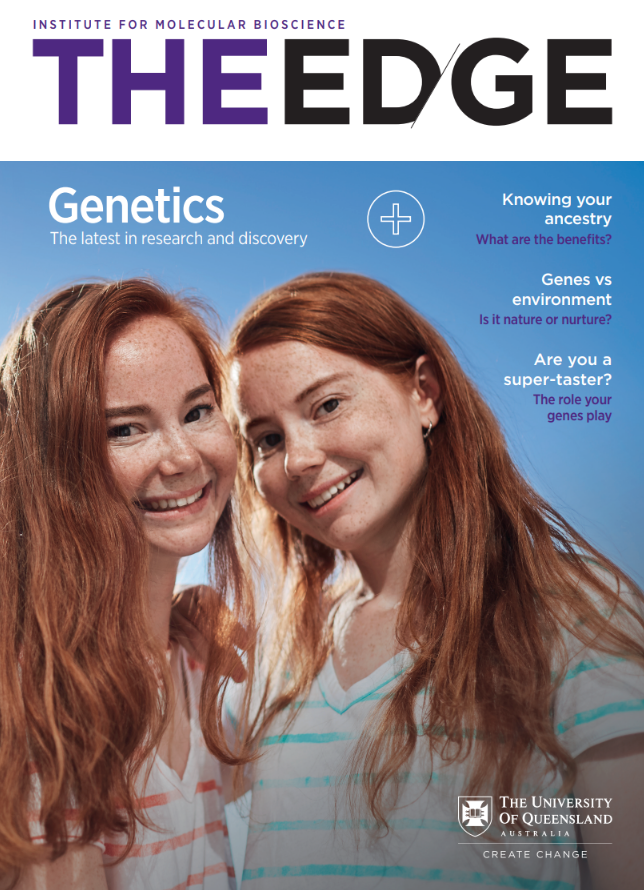
The Edge: Genetics
People have known for thousands of years that parents pass traits to their children, but it is only relatively recently that our technology has caught up to our curiosity, enabling us to delve into the mystery of how this inheritance occurs, and the implications for predicting, preventing and treating disease.
Subscribe to our newsletter
Get the latest research straight to your inbox.
Stay up-to-date as we answer questions about hot topics, and share the latest news at IMB, Australia’s #1 research institute.
General enquiries
+61 7 3346 2222
imb@imb.uq.edu.au
Media enquiries
IMB fully supports UQ's Reconciliation Action Plan and is implementing actions within our institute.
Support us
Donate to research
100% of donations go to the cause