
Get the latest research to your inbox
- Postdoctoral Research FellowInstitute for Molecular Bioscience
- Research Assistant - Natural Product ChemistryInstitute for Molecular Bioscience
Genomics in Health Team
Group Leader
Associate Professor Sonia Shah
National Heart Foundation Future Leader FellowNational Heart Foundation Future Leader Fellow, Senior Principal Research Fellow –Group LeaderInstitute for Molecular BioscienceResearcher profile is public:1Supervisor:Researcher biography:My group's research uses large-scale genomic data to address knowledge gaps in disease, with a particular focus on cardiovascular disease.
Research programme
1. Cardiovascular disease research using big-data and genomics: with the goal of improving prevention and treatment of cardiovascular disease. By focusing on underrepresented groups, including women, my research aims to also address inequity in cardiovascular outcomes. I am the lead of the South Asian Genes and Health in Australia (SAGHA) study, which aims to increase representation of Australian South Asians in cardiovascular and genomics research. See saghaus.org for further details.
2. Drug genomics: I'm interested in using genomic approaches to predict drug effects, including identification of drug repurposing opportunities as well as identifying unknown adverse effects of medication.
3. Liver transplant research: In this collaboration with the QLD Liver Transplant Unit, we are using genomics to understand the effect of normo-thermic perfusion (a new organ storage method) on liver function, with the long-term goal of improving our ability to predict transplant outcomes.
Career summary: I was awarded my PhD from University College London (UK) in cardiovascular genetics. I began my post-doctoral fellowship under the mentorship of Prof Peter Visscher at the Queensland Brain Institute in 2013. Between 2016-2018, I was the lead analyst for the International Heart Failure Genetics Consortium (HERMES). In 2018, I was awarded an NHMRC Early Career Researcher Fellowship to investigate the relationship between cardiovascular and brain-related disorders using large-scale genetic and genomic data, under the mentorship of Prof Naomi Wray. I currently hold a National Heart Foundation Future Leader Fellowship.
Recognition:
2024 Australian Academy of Science Ruth Stephens Gani Medal for outstanding contribution to genetics research
2023 1 of 5 global finalists for the Nature Inspiring Women in Science (Scientific Achievement Award)
2023 Lifesciences QLD Rose-Anne Kelso Award
2023: Named in Australia's Top 25 Women in Science by Newscorp
2022 Queensland Young Tall Poppy Award
2022 UQ Foundation Research Excellence Award
2021/2022 Australian Superstar of STEM,
2020 Genetic Society of Australasia Early Career Award
2020 Women in Technology Rising Star Science Award
Researchers
Dr Clara Jiang
Postdoctoral Research FellowInstitute for Molecular BioscienceResearcher profile is public:1Supervisor:Researcher biography:Clara Jiang is a postdoctoral research fellow at the Institute for Molecular Bioscience, the University of Queensland. Clara's research focuses on using genomic and transcriptomic analysis to investigate the genetic basis of cardiovascular and psychiatric disorders, with a particular focus on female health, as well as using statistical genomic approaches to explore possible opportunities for drug repurposing. Clara graduated from the University of Queensland with Bachelor of Advanced Science (First Class Honours) in 2017, and was awarded the University Medal. Clara was awarded her PhD at the University of Queensland in 2021, where she utilised bioinformatic approaches and molecular experiments to decipher the genetic aetiology of breast cancer, specifically the regulatory role of transposons or 'jumping genes' in modulating the transcriptional landscape in the cancer state. Clara is also a UQ Wellness ambassador and an advocate for promoting equity, diversity and inclusion in academia.
Students
Dr Solal Chauquet
Postdoctoral Research FellowInstitute for Molecular BioscienceResearcher profile is public:1Supervisor:Researcher biography:Solal Chauquet is an early career postdoctoral fellow focused on using genetic and genomics to investigate liver transplantation and liver diseases. He finished a master of Neuroscience at the Université de Bordeaux, a Master in Bioinformatics from the University of Queensland and recently his PhD genomics where he developed a specialized proficiency in the analysis of liver omics data.
Ms Zoe Hunter
PhD studentInstitute for Molecular BioscienceResearcher profile is public:1Supervisor:Mr Utpala Nanda Chowdhury
Researcher profile is public:0Supervisor:- Higher degree by research (PhD) studentInstitute for Molecular Bioscience
- Novel discoveries are born from innovation. Teams of scientists young and old gather to apply their minds and skills to the world's most challenging problems. Rarely is the spotlight shone on the newest members of the team, the PhD students commencing their careers under the leadership and guidance of experienced supervisors.
- Are you a leftie or a rightie? And why are researchers so interested in this seemingly superficial trait?
UQ Centre for Cardiac and Vascular Biology
Chief Investigators
Professor Nathan Palpant
National Heart Foundation of Australia Future Leader Fellow - Group LeaderInstitute for Molecular BioscienceResearcher profile is public:1Supervisor:Researcher biography:Career Summary: 2009: PhD, University of Michigan, USA with training in cardiac physiology, modelling myocardial ischemia in vivo and in vitro, and development of therapeutic approaches for myocardial ischemia; 2009–2015: Postdoctoral Research Fellow, University of Washington, Institute for Stem Cell and Regenerative Medicine, USA with training in stem cell biology, genomics, genome editing, and cell therapeutics for ischemic heart disease; 2015–current: Group Leader, University of Queensland (UQ), Institute for Molecular Bioscience; 2022-current: Associate Professor, UQ; 2018–2021 and 2023-2026: National Heart Foundation Future Leader Fellow. Dr. Palpant's research team has expertise in human stem cell biology, computational genomics, and cardiac physiology, which enables them to translate outcomes from cell biology and genomics to disease modelling, drug discovery, and preclinical modelling.
Body:Latest publication
Dr Palpant and colleagues have published the most in-depth study of exactly how human stem cells can be turned into heart cells. The work involved measuring changes in gene activity in tens of thousands of individual cells as they move through the stages of heart development.
Unlike those tissues, the heart does not have the capacity for self-repair after damage (such as a heart attack). This is one reason why heart disease is the leading cause of death worldwide. This research may help us find ways to repair the heart in the future. Read more
Highlights
The Stem Cells and Cardiovascular Development lab run by Dr Nathan Palpant uses human pluripotent stem cells (hPSCs), genomics, genome editing, and disease modelling to study mechanisms controlling cardiovascular development and disease.
Cardiovascular disease is the leading cause of death worldwide and new therapeutics are required to address growing public health demands. Expanding treatment options for cardiovascular diseases requires interdisciplinary research from developmental biology to translation.
To this end, Dr Palpant leads functional genomics and epigenetic studies at single cell resolution and across diverse cardiac and vascular fates to determine the genetic basis of cell identity and fate.
His team is developing stem cell models of disease for drug discovery. They are also building links with clinician/researchers bringing together stem cell biology, mechanical-assist devices, and large animal disease models to identify new approaches to address cardiovascular disease.
Dr Palpant received training in cardiac physiology (PhD, University of Michigan) and developmental biology and genomics (University of Washington), resulting in 27 publications in high-impact journals including Nature, Nature Protocols, and Development.
In November 2015, Dr Palpant relocated to The University of Queensland’s Institute for Molecular Bioscience to establish the Stem Cells and Cardiovascular Development Laboratory.
During his career, Dr Palpant has received internationally competitive awards and positions including:
- The International Society for Heart Research Young Investigator Award
- International speaking invitations in the US, Europe, Australia, and Asia
- He is an IMB Group Leader, Co-Director of Stem Cells Australia’s Cardiac Repair and Regeneration theme, and Co-Director of the Queensland Facility for Advanced Genome Editing.
Video
Using genomics to elucidate developmental cell lineage decisions, Dr Nathan Palpant

Connect


Dr Emma Gordon
Adjunct Senior FellowInstitute for Molecular BioscienceResearcher profile is public:1Supervisor:Researcher biography:Dr Gordon's research is focused on the formation and maintenance of the blood and lymphatic vascular systems. Vessels form complex branched networks that supply oxygen and nutrients to all body tissues. The signals controlling blood vessel expansion, identity and migration are all downstream of a single, common complex at the cell surface, yet exactly how this diverse range of functions is differentially regulated, depending on the physiological need, remains unknown.
The specific focus of Dr Gordon's research is to determine the precise molecular signals that control cell adhesion within the vessel wall the surrounding environment. If the signals controlling cell adhesion become deregulated, normal vessel growth and function is lost. This contributes to the progression of a wide range of human diseases, including cancer growth and metastasis, diabetic eye disease and stroke. Dr Gordon aims to use novel biological models, biochemical assays and imaging techniques to better understand vessel biology, which will enable improved treatment of disease and aid in the development of vascularised, bioengineered organs.
Dr Gordon received her Bachelor of Science (2005) and PhD (2011) from The University of Adelaide, after which she undertook six years of postdoctoral studies at Yale University in the USA and Uppsala University in Sweden. With the support of an ARC DECRA Fellowship, Dr Gordon relocated to IMB in 2017 to establish her independent research career as an IMB Fellow. In 2019, she was appointed as Group Leader of the Vessel Dynamics Laboratory.
Body:Associate Professor Anne Lagendijk
ARC Future FellowInstitute for Molecular BioscienceResearcher profile is public:1Supervisor:Body:Highlights
Dr Anne Lagendijk's research focusses on the development and maintenance of a functional blood vessel network. These cells that make up the vessels continuously adapt their size, adhesiveness and compliance order to ensure the right balance between vessel integrity and permeability in a context dependent manner. Mechanical cues play a major role in the functional adaptation of blood vessels. Despite ongoing research unraveling the structural components of mechanical hubs in the cells, it is essential to assess the magnitude of forces that are transduced at these sites and the biological consequences for vessel function. She has previously developed a VE-cadherin tension biosensor line in zebrafish. This line provides the first vertebrate model that reports intra-molecular tension. Dr Lagendijk utilised this tool to identify changes in junctional organisation and VE-cadherin tension that occur as arteries mature and revealed molecular pathways that allow for this maturation to happen.
In addition, she has developed new disease models that are allowing her to probe the initiating mechanisms of vascular malformations that lead to neurological deficits and stroke with unprecedented cellular and subcellular resolution. Dr Lagendijk is currently continuing on from her previous work by investigating how forces and mechanically induced pathways at distinct mechanically active sites in the cell contribute to building and maintaining a healthy vasculature.
Pages
Strawberry DNA extraction activity
Extract and view DNA from a strawberry using common household ingredients.
Get started
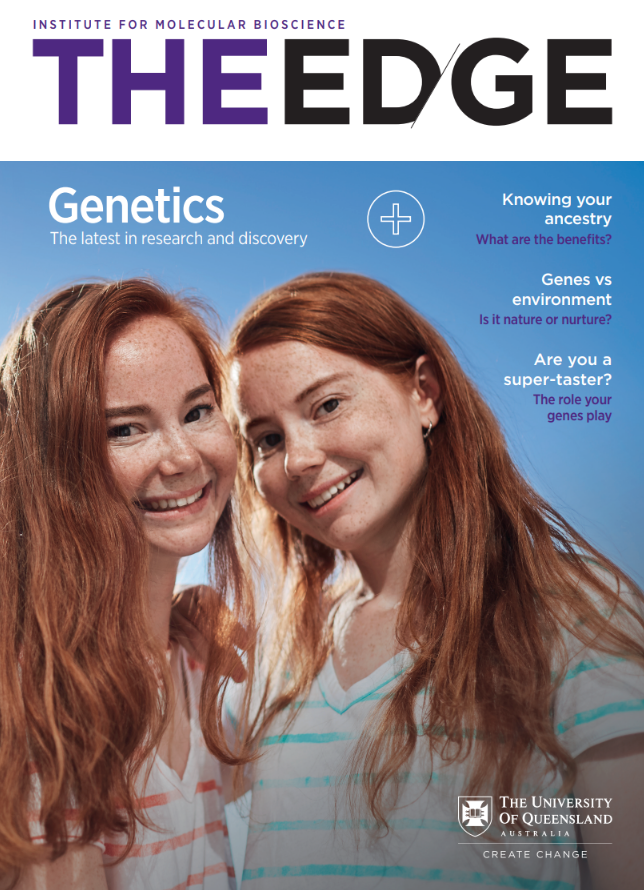
The Edge: Genetics
People have known for thousands of years that parents pass traits to their children, but it is only relatively recently that our technology has caught up to our curiosity, enabling us to delve into the mystery of how this inheritance occurs, and the implications for predicting, preventing and treating disease.
Subscribe to our newsletter
Get the latest research straight to your inbox.
Stay up-to-date as we answer questions about hot topics, and share the latest news at IMB, Australia’s #1 research institute.
General enquiries
+61 7 3346 2222
imb@imb.uq.edu.au
Media enquiries
IMB fully supports UQ's Reconciliation Action Plan and is implementing actions within our institute.
Support us
Donate to research
100% of donations go to the cause


