

Get the latest research to your inbox
Doolan Group
Group Leader
Professor Denise Doolan
Professorial Research Fellow & Group Leader & NHMRC Leadership Fellow & Group LeaderInstitute for Molecular BioscienceResearcher profile is public:1Supervisor:Researcher biography:Professor Denise Doolan is Director of Research at the Institute for Molecular Bioscience. She joined IMB in 2022 and was previously Deputy Director of the Australian Institute of Tropical Health and Medicine, and Director of the JCU Centre for Molecular Therapeutics, at James Cook University.
She is a molecular immunologist, working on the development of vaccines, diagnostics and host-directed therapeutics for infectious and chronic diseases that impact global public health, with a particular focus on malaria. Her cross-disciplinary research program spans host-pathogen immunity, antigen discovery, vaccine engineering, and biomarker discovery. A particular interest is the application of state-of-the-art genome-based technologies and human models of disease system to identify novel targets for intervention against disease or that predict risk of disease.
She is a recognized world expert in malaria immunology, vaccinology, and omic-based approaches for therapeutic and diagnostic development. She has been honoured as a Fellow of the International Society for Vaccines (2017) and a Fellow of the Australian Society of Parasitology (2019) in recognition of her leadership and contribution to health and medical science in Australia and internationally.
Professor Doolan serves on a number of Executive Boards and Advisory Boards. Most recently, she has been elected as President of the International Society for Vaccines (2021-2023), and has been appointed to the Federal Government’s Australian Medical Research Advisory Board (AMRAB; 2021-2026) to provide specialist insights into Australia’s medical research and innovation priorities.
Body:
Researchers
Dr Yomani Sarathkumara
Postdoctoral Research FellowInstitute for Molecular BioscienceResearcher profile is public:1Supervisor:Researcher biography:Dr. Yomani Sarathkumara's research focuses on characterising humoral immune responses to Epstein-Barr virus (EBV) in EBV-associated diseases.
During her PhD at James Cook University, Australia, she identified novel antibody biomarkers for EBV-associated cancers, including natural killer/T-cell lymphoma and Hodgkin lymphoma, using well-characterised hospital-based case-control samples from the AsiaLymph study—a large, multicentre epidemiological investigation of lymphoma and related haematologic malignancies conducted across Asia in collaboration with the U.S. National Cancer Institute (NCI). She also identified antibody markers predictive of clinical responses in EBV-positive lymphoma patients treated with EBV-specific T-cell immunotherapy in Phase I clinical trials conducted by Baylor College of Medicine, USA.
Her Honours research at Northumbria University, UK, focused on identifying antibody responses to a fungal antigen associated with Pigeon Fancier's Lung disease. For her Master's by Research (MPhil) from 2016–2018, conducted in collaboration with the University of Peradeniya, Sri Lanka, and Hokkaido University, Japan, she demonstrated that hantavirus exposure is a major risk factor for developing chronic kidney disease of unknown aetiology (CKDu) in Sri Lanka—a significant public health concern in agricultural communities. This study earned the President's Award for Scientific Research - 2019 in Sri Lanka.
Following her PhD, Dr. Sarathkumara joined the University of Queensland (UQ) as a Postdoctoral Research Fellow under the supervision of Professor Denise Doolan. Building on her doctoral work, she is currently investigating the potential role of EBV in triggering autoimmune diseases such as multiple sclerosis (MS), aiming to identify diagnostic and predictive antibody biomarkers. This work is conducted in collaboration with the University of Texas and the Oklahoma Medical Research Foundation, USA. In parallel, she is also examining antibody responses in individuals with acute EBV infection through a collaboration with UMass Chan Medical School, University of Massachusetts, USA.
Her research integrates high-throughput serological profiling, statistical modelling, and immunoassay development, and is supported by strong international collaborations.
Dr Anouschka Akerman
Postdoctoral Research FellowInstitute for Molecular BioscienceResearcher profile is public:1Supervisor:Dr Ashton Kelly
Researcher profile is public:0Supervisor:Ms Maggie King
Principal Research AssistantInstitute for Molecular BioscienceResearcher profile is public:0Supervisor:Students
Ms Brenna Daily
PhD Student & Casual Senior Research AssistantInstitute for Molecular BioscienceResearcher profile is public:0Supervisor:Miss Nadia Boulahia
PhD StudentInstitute for Molecular BioscienceResearcher profile is public:0Supervisor:Miss Kiara Knuckey
StudentInstitute for Molecular BioscienceResearcher profile is public:1Supervisor:Collins Group
Group Leader
Professor Brett Collins
Director, Centre for Cell Biology of Chronic DiseaseNHMRC Leadership Fellow - GL & Centre Director of Institute for Molecular BioscienceInstitute for Molecular BioscienceResearcher profile is public:1Supervisor:Researcher biography:Brett Collins is an NHMRC Career Development Fellow and head of the Molecular Trafficking Lab at UQ's Institute for Molecular Bioscience. He was a lead investigator in the seminal structural studies of AP2, the protein adaptor molecule central to clathrin-mediated endocytosis, and has since defined the molecular basis for the function of critical proteins regulating membrane trafficking and signalling at the endosome organelle. His team is now focused on understanding how discrete molecular interactions between proteins and lipids control these processes in human cells.
Associate Professor Collins was awarded his PhD in 2001 and has published over 75 papers including in Cell, Nature, Nature Structural and Molecular Biology, Developmental Cell, and The Proceedings of the National Academy of Sciences USA, altogether cited more than 3100 times. He is the recipient of 3 prestigious fellowships, including a previous Career Development Award from the National Health and Medical Research Council and a Future Fellowship from the Australian Research Council, and was awarded the University of Queensland Research Excellence Award in 2008. In 2015 he was awarded the Emerging Leader Award of the ANZSCDB and in 2016 the Merck Research Medal from the ASBMB. He is currently the President of the Queensland Protein Group.
Body:Highlights
Seeing the structure of a protein at the atomic level as an undergrad set off a career in structural biology for Brett Collins. His interest in how cells work, and the techniques used to visualise the complex interaction mechanisms of the structures within, earned him his PhD in 2001. Postdoctorate work at Cambridge University steered him towards ‘membrane trafficking’, the term used to describe how proteins are moved from one part of a cell to another, or indeed between cells, via a complex system of membranes.
Now, as head of IMB’s Membrane Trafficking Group, he’s using techniques such as X-ray crystallography and cryo-electron microscopy to visualise protein structure at the atomic level to investigate why things sometimes go wrong with our cells’ protein transport system. Faulty proteins are known to cause the development of neurodegenerative conditions such as Parkinson’s and Alzheimer’s disease, and muscular dystrophy.
Connect


Researchers
Dr Shan Zheng
Postdoctoral Research FellowInstitute for Molecular BioscienceResearcher profile is public:1Supervisor:Students
Ms Denaye Eldershaw
Global Challenges ScholarInstitute for Molecular BioscienceResearcher profile is public:1Supervisor:Ms Meihan Liu
Research StaffInstitute for Molecular BioscienceResearcher profile is public:1Supervisor:Mr Dominic Hoyle
PhD StudentInstitute for Molecular BioscienceResearcher profile is public:0Supervisor:Ms Ella Stephens
PhD StudentInstitute for Molecular BioscienceResearcher profile is public:0Supervisor:Mr Mingze Xu
StudentInstitute for Molecular BioscienceResearcher profile is public:1Supervisor:- Higher degree by research (PhD) studentInstitute for Molecular Bioscience
- Research Fellow/Senior Research officerInstitute for Molecular Bioscience
- Our program is designed to create a cohort of outstanding researchers who use multidisciplinary approaches to discover the cellular basis of chronic diseases, enabling us to develop future disease therapies.
- Associate Laboratory TechnicianInstitute for Molecular Bioscience
Pages
Strawberry DNA extraction activity
Extract and view DNA from a strawberry using common household ingredients.
Get started
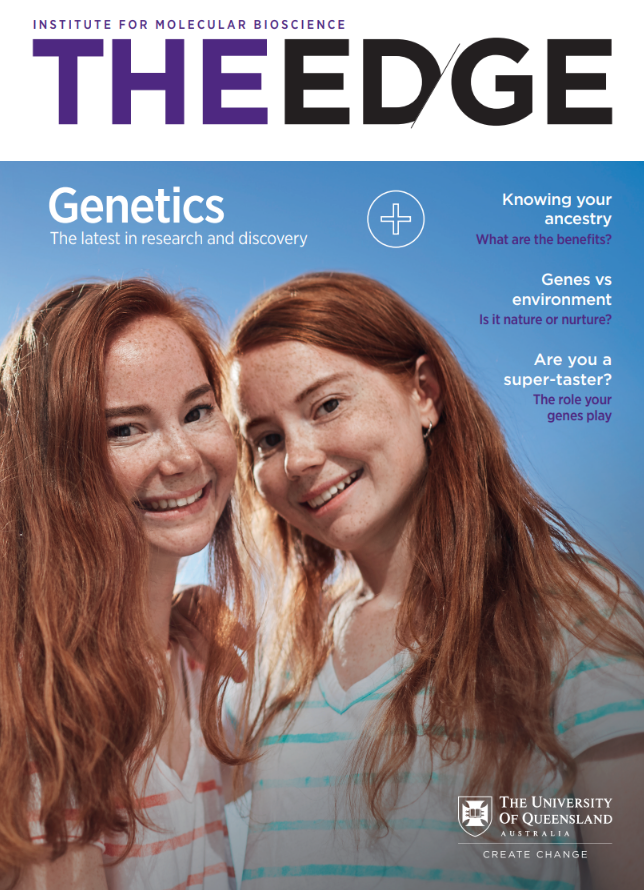
The Edge: Genetics
People have known for thousands of years that parents pass traits to their children, but it is only relatively recently that our technology has caught up to our curiosity, enabling us to delve into the mystery of how this inheritance occurs, and the implications for predicting, preventing and treating disease.
Subscribe to our newsletter
Get the latest research straight to your inbox.
Stay up-to-date as we answer questions about hot topics, and share the latest news at IMB, Australia’s #1 research institute.
General enquiries
+61 7 3346 2222
imb@imb.uq.edu.au
Media enquiries
IMB fully supports UQ's Reconciliation Action Plan and is implementing actions within our institute.
Support us
Donate to research
100% of donations go to the cause