

Get the latest research to your inbox
Coin Group
Group Leader
Hon Assoc Professor Lachlan Coin
Honorary ProfessorInstitute for Molecular BioscienceResearcher profile is public:0Supervisor:Body:Highlights
Professor Lachlan Coin is a mathematician with a research focus on developing genomics and bioinformatics tools in infectious disease and cancer. He was originally drawn by the rigour and intellectual challenge of pure mathematics but now uses his maths background as a toolkit for solving complex problems in analysing high throughput biological data.
Professor Coin is best known for using approaches borrowed from machine learning, statistics and probability theory to interrogate genomic data.
In particular, Professor Coin has focussed on using these approaches to uncover genomic deletions and amplifications and has identified changes that are associated with increased risk of obesity and diabetes.
He has also developed approaches for finding minimal biomarker signatures associated with disease, and has applied these approaches to find biomarkers that distinguish bacterial from viral infection, and for the presence of active tuberculosis infection. He is also applying his methodology to develop a diagnostic tool for cancer from cell free DNA
Ultimately, Professor Coin is motivated by making discoveries that are routinely used in clinical practice and to inform public policy to improve health outcomes.
Professor Coin holds an Honorary Professor appointment with UQ, and is a Professor at the Doherty Institute at the University of Melbourne.
Connect


Researchers
Dr Quan Nguyen
Senior Research Fellow & Group LeaderInstitute for Molecular BioscienceResearcher profile is public:1Supervisor:Researcher biography:Dr Quan Nguyen is a Group Leader at the Institute for Molecular Bioscience (IMB), The University of Queensland, where he leads the Genomics and Machine Learning (GML) Laboratory. His research focuses on understanding pathological processes within tissues to identify biomarkers for early diagnosis, patient stratification, and prediction of treatment response. His work integrates statistical machine learning techniques with advanced genomic technologies, combining single-cell and spatiotemporal sequencing data with tissue imaging to uncover causal links between genotypes and phenotypes across biological scales, from single cell, to tissue microenvironment, organ, multi-organ and population level. By studying cell-cell interactions, his research also contributes to the discovery of novel drug targets and improved understanding of drug mechanisms and toxicity. The GML Laboratory also develops spatiotemporal experimental platforms for large-scale biomarker profiling and validation in preclinical models and patient cohorts.
Dr Nguyen completed a PhD in Bioengineering at the University of Queensland in 2013, postdoctoral training in Bioinformatics at RIKEN institute in Japan in 2015, a CSIRO Office of Chief Executive (OCE) Research Fellowship in 2016, an IMB Fellow in 2018, an Australian Research Council DECRA fellowship in 2021, and is a National Health and Medical Research Council leadership fellow. He has authored 86 publications in top-tier journals, like Cell, Nature Genetics, and Nature Method, averaging ~45.5 citations per paper, and led the development of 14 software tools with over 250,000 downloads. His recognised expertise is demonstrated through 14 national/international awards, numerous invited talks (21 international, 42 national), invited grant reviews for funding bodies in nine countries, and active editorial roles for BMC Cancer and Genome Medicine. His commitment to propelling the field forward is evident in leading roles within key consortia and forums and his dedication to organise training workshops and conferences. He has secured over $31 million in grant funding as a chief investigator from national and international funding agencies (e.g., ARC, NHMRC, MRFF, DoD, NCI) and from industry partners, with approximately $11million directly supporting his lab's groundbreaking work.
Students
Dr Son Nguyen
Higher degree by research (PhD) studentInstitute for Molecular BioscienceResearcher profile is public:0Supervisor:Ms Miranda Pitt
Higher degree by research (PhD) studentInstitute for Molecular BioscienceResearcher profile is public:0Supervisor:Mr Haojing Shao
Higher degree by research (PhD) studentInstitute for Molecular BioscienceResearcher profile is public:1Supervisor:Mr Chenxi Zhou
Higher degree by research (PhD) studentInstitute for Molecular BioscienceResearcher profile is public:1Supervisor:Mr Hyun Jae Lee
Higher degree by research (PhD) studentInstitute for Molecular BioscienceResearcher profile is public:1Supervisor:Ms Janice Reid
Honours studentInstitute for Molecular BioscienceResearcher profile is public:1Supervisor:Ms Dilys Li
Honours studentInstitute for Molecular BioscienceResearcher profile is public:1Supervisor:Support staff
Higher Degree by Research
Professor Matt Sweet
UQ Amplify Professorial Research Fellow and Group LeaderInstitute for Molecular BioscienceResearcher profile is public:1Supervisor:Researcher biography:Matt Sweet is a Group Leader at the Institute for Molecular Bioscience (IMB) at The University of Queensland, Brisbane, Australia. Matt studies innate immunity, the body's danger sensing system that responds to infection, injury and dysregulated homeostasis, and the role of this system in health and disease. Matt's research team focuses on manipulating the innate immune system for the development of anti-infective and anti-inflammatory strategies. To do so, his lab characterizes the roles of specific innate immune pattern recognition receptors and their downstream signalling pathways/gene products in inflammatory and infectious disease processes, with a particular focus on immunometabolism. He has authored >190 journal articles and book chapters, including in Science (2), Science Translational Medicine, Science Immunology (2), Nature Immunology, Nature Reviews Immunology, Nature Genetics, Nature Communications(4), PNAS USA (8), Cell Metabolism, Developmental Celland Journal of Experimental Medicine (2), and his career publications have accrued ~23,000 citations. Matt has held several leadership roles at the IMB, including IMB Director of Higher Degree Research (DHDR, 2021-2025), member of the IMB Senior Executive Committee (2023-2025), founding Director of the IMB Centre for Inflammation and Disease Research (2014-2018), and Deputy Head of the IMB Division of Cell Biology and Molecular Medicine (2014-2018).
Biography
I was awarded a PhD (The University of Queensland) in 1996 for my research under the supervision of Prof David Hume into gene regulation in macrophages, immune cells with important roles in health and disease. I subsequently undertook a short postdoctoral position in the same laboratory, focusing on the activation of macrophages by pathogen products. I then embarked on a CJ Martin post-doctoral training fellowship with Prof Eddy Liew, FRS at the University of Glasgow in Scotland. Returning to The University of Queensland, I had a prominent role within the Cooperative Research Centre for Chronic Inflammatory Diseases (including as UQ node head from 2007-2008) and was appointed as a Group Leader at the IMB in 2007. Since that time, I have held several fellowships, including an ARC Future Fellowship, two NHMRC Senior Research Fellowships, an NHMRC Leadership Fellowship, and a Le Studium Visiting Researcher Award.
Key discoveries
CpG-containing DNA as an activator of innate immunity, and characterization of the receptor (TLR9) detecting this microbial component.
The IL-1 receptor family member ST2 as a critical regulator of innate immunity and inflammation.
Inflammatory and antimicrobial functions of histone deacetylase enzymes (HDACs) in macrophages.
Effects of the growth factor CSF-1 on inflammatory responses in macrophages.
Mechanisms responsible for divergence in TLR responses between human and mouse macrophages, as well as the functional consequences of such divergence.
The first description of the p19/EBI3 heterodimer, subsequently renamed by others as the cytokine IL-39.
TLR-inducible zinc toxicity as an antimicrobial weapon of macrophages, as well as its deficiency in Cystic Fibrosis.
Host evasion strategies used by the bacterial pathogens Salmonella enterica serovar Typhimurium and uropathogenic E. coli.
SCIMP as a novel TLR adaptor that mediates TLR tyrosine phosphorylation and selective cytokine outputs.
Genes and pathways associated with the severity of chronic liver disease.
Molecular mechanisms controlling macrophage immunometabolism, as well as associated inflammatory and antimicrobial responses.
Anti-inflammatory and antibacterial activities of the metabolite ribulose-5-phosphate.
Role of mitochondrial fission in antibacterial defence.
Research training
I have supervised or co-supervised 34 completed PhD students and 26 completed honours students, and have mentored many post-doctoral researchers over the course of my career. Many of my former staff and students continue to have active research careers around the world (USA, UK, Europe, Australia), including as independent laboratory heads. Others have key roles in and industry and government. I currently supervise 4 PhD students in my laboratory, co-supervise 3 PhD students in other laboratories, and oversee the research activities of 3 post-doctoral researchers in my group. Current and former staff/students have received numerous fellowships and awards during their research careers (e.g. ARC DECRA, NHMRC CJ Martin fellowship, UQ post-doctoral fellowship, Smart State scholarship). I have also examined 32 PhD theses and 3 MPhil theses, primarily in the fields of innate immunity, inflammation and host defence.
Professional activities
I have served as an editorial board member for several international journals including Journal of Leukocyte Biology (current), Seminars in Cell & Developmental Biology (current), and Immunology and Cell Biology (past). I have served on NHMRC project grant review panels in 2007, 2008, 2009, 2012 (as panel chair) and 2014, NHMRC Ideas panels in 2020 and 2024, NHMRC Investigator panels in 2021 and 2022, as well as a member of the NHMRC RGMS user reference group committee from 2010-2012. I acted as national representative for the Australasian Society of Immunology (ASI) Infection and Immunity special interest group from 2012-2017 and currently serve as a board member for the International Society for Zinc Biology. At UQ, I served as chair of an animal ethics committee from 2013-2014 and co-organized the UQ Host-Pathogen interaction network from 2007-2010 (prior to the establishment of the Australian Infectious Diseases Research Centre). Other leadership roles have included IMB Director of Higher Degree Research (DHDR, 2021-2025), member of the IMB Senior Executive Committee (2023-2025), founding Director of the IMB Centre for Inflammation and Disease Research (2014-2018), and Deputy Head of the IMB Division of Cell Biology and Molecular Medicine (2014-2018).
I have made extensive contributions to conference organization in my discipline. I co-organized the national TLROZ2009 and TLROZ2012 conferences, I organized the first ever Australasian Society for Immunology (ASI) Infection and Immunity workshop (2009), was chair of the ASI Program Committee and co-organizer of the Infection and Immunity workshop for ASI2017, and I co-organized the annual IMB Inflammation Symposium (2014-2018). I also co-chaired the 2019 World Conference of Inflammation (Sydney, September 2019). In addition, I have been a member of the organizing committee for ASI2009, the 2014 International Cytokine and Interferon Society conference, the Lorne Infection and Immunity conference (2014-2020), the Queensland Immunology Networking Symposium (2020-2024), the Brisbane Immunology Group annual meeting (2008-2024), and the International Society for Zinc Biology Conference (2026).
Body:Highlights
Professor Matt Sweet uses techniques in immunology, cell biology and biochemistry to understand how the innate immune system functions in health and disease. His research focuses on characterizing genes and pathways in macrophages that either drive inflammation or are involved in the clearance of bacterial pathogens. The ultimate aim of his research is to devise strategies to manipulate the innate immune system to limit pathological inflammation and/or unleash its power against infections caused by antibiotic-resistant bacteria.
During his career, he has discovered mechanisms by which specific pathogen products activate macrophages; identified regulatory mechanisms controlling innate immune activation and inflammation; defined roles for histone deacetylase enzymes in infection and inflammation; elucidated antimicrobial responses used by macrophages to destroy bacteria, as well as mechanisms used by bacterial pathogens such as Salmonella and uropathogenic E. coli to subvert these responses; and identified molecular mechanisms by which immune cells use immunometabolism to drive inflammation and combat infections.
Professor Matt Sweet completed his PhD in 1996 at The University of Queensland, and then undertook a CJ Martin postdoctoral training fellowship at the University of Glasgow, before returning to Australia. He is currently an NHMRC Leadership Fellow at the Institute for Molecular Bioscience. He has authored >170 journal articles and book chapters, including publications in Science (x2), Science Immunology, Science Translational Medicine, Nature Immunology, Nature Genetics, Nature Communications (x3), Journal of Experimental Medicine (x2) and PNAS (x5). Professor Sweet currently serves on the editorial boards of several international journals including Journal of Leukocyte Biology and Seminars in Cell and Developmental Biology.
Professor Sweet has served as the Director of Training for IMB since 2021, overseeing PhD and Masters student recruitment and training. He has a strong focus on research culture and on delivering excellence in HDR student training and development. Professor Sweet has supervised/co-supervised more than 35 PhD students and more than 20 Honours students, and his former students have leading roles in Academia, Industry, and Government. He has won inaugural prizes from the Society for Leukocyte Biology (2021) and IMB (2016) for mentorship and leadership.
Connect

Professor Irina Vetter
Director for Higher Degree Research & NHMRC Leadership Fellow & Group LeaderInstitute for Molecular BioscienceResearcher profile is public:1Supervisor:Researcher biography:I am an NHMRC Leadership Fellow with joint apointments at the Institute for Molecular Bioscience (IMB) and School of Pharmacy, UQ. My research interests lie in the fields of peripheral pain mechanisms, target identification and analgesic drug discovery. I investigate the contribution of ion channels to sensory neuronal physiology using highly subtype-selective toxins isolated from venomous animals with the aim to develop novel analgesics with improved efficacy and tolerability.
Body:Highlights
Associate Professor Irina Vetter has a strong background in neuropharmacology, pain models, toxinology and high-throughput screening. Currently her primary research interests lie in the fields of peripheral pain mechanisms, target identification, biodiscovery of venom peptide ion channel modulators and analgesic drug discovery.
Associate Professor Vetter has always been fascinated by how we perceive the world around us, in particular, the role of sensory neurons in the body. Sensory neurons are an intricate network of nerve cells that convert external stimuli from the environment into messages within the body, like pain. Her research is demystifying the different pathways that contribute to pain in various disease states. She is using biomedical research and pharmacology to develop pain treatments from venoms and toxins.
Associate Professor Vetter is an ARC Future Fellow and Deputy Director of the Centre for Pain Research at The University of Queensland. She is a registered pharmacist and has worked in hospital as well as community pharmacy. She obtained her PhD in 2007 from the School of Pharmacy, and conducted postdoctoral studies as an NHMRC postdoctoral fellow under Prof Geoffrey Goodhill at the Queensland Brain Institute and under Prof Richard J Lewis at the Institute for Molecular Bioscience in the areas of axon guidance and venom peptide pharmacology
Video
Connect


- Research AssistantInstitute for Molecular Bioscience
- PhD studentThe Institute for Molecular Bioscience
Pages
Strawberry DNA extraction activity
Extract and view DNA from a strawberry using common household ingredients.
Get started
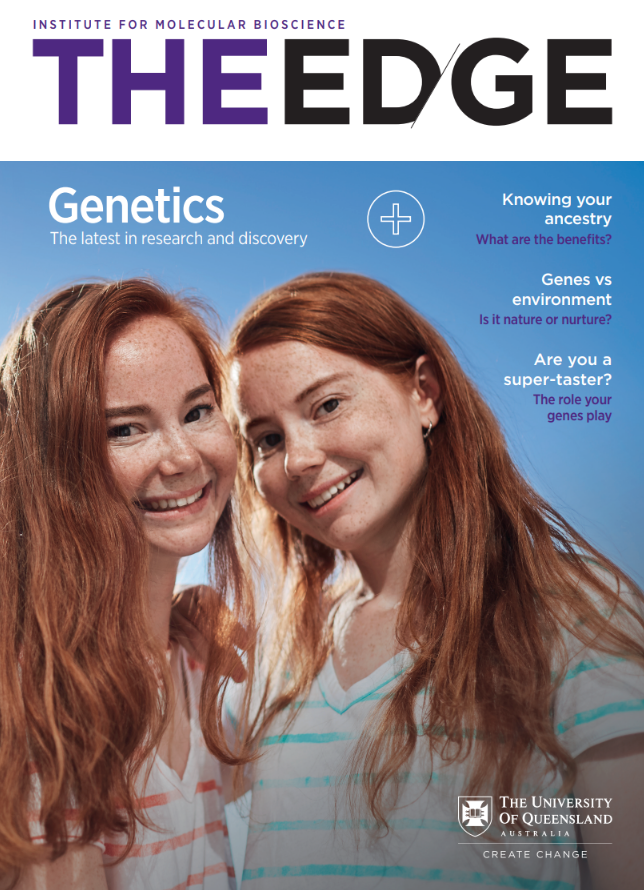
The Edge: Genetics
People have known for thousands of years that parents pass traits to their children, but it is only relatively recently that our technology has caught up to our curiosity, enabling us to delve into the mystery of how this inheritance occurs, and the implications for predicting, preventing and treating disease.
Subscribe to our newsletter
Get the latest research straight to your inbox.
Stay up-to-date as we answer questions about hot topics, and share the latest news at IMB, Australia’s #1 research institute.
General enquiries
+61 7 3346 2222
imb@imb.uq.edu.au
Media enquiries
IMB fully supports UQ's Reconciliation Action Plan and is implementing actions within our institute.
Support us
Donate to research
100% of donations go to the cause