
IMB's latest news, explainers and more


Supporting life-saving research at CCRG

Read more

Get the latest research to your inbox

Subscribe
 

  • Principal Research Assistant
    Institute for Molecular Bioscience
  • Honours student
    Institute for Molecular Bioscience
  • O'Sullivan Lab Team

    Group Leader

    Professor Michael O'Sullivan

    Professorial Research Fellow
    Institute for Molecular Bioscience
    Researcher profile is public: 
    1
    Supervisor: 
    Researcher biography: 

    Overview

    Professor Michael O'Sullivan is a neuroscientist, neurologist and group leader at the Institute for Molecular Bioscience (IMB). His main research interest is the neurobiology of brain injury, with an emphasis on mechanisms of resilience and recovery of the brain after injury. His previous work has developed understanding in two broad areas:

    • The cognitive neuroscience of memory and cognitive control – and how distributed and dynamic networks in the brain support these functions, which are often affected by injury.
    • How injury alters network structure and function leading to symptoms in day-to-day life - and intrinsic mechanisms of neural adaptation that modulate the effect of injury

    At the Institute for Molecular Bioscience, O'Sullivan is building a research program on cellular and molecular events that influence adaptation and recovery, including the role of innate immunity and glial cells. This program includes novel approaches to neuroprotection and the role of astrocytes as key regulators of glutamate and neuroinflammation. A major theme is identification of therapeutic targets, and evaluation of disease progression or treatment response in vivo, using advanced human imaging with MRI, PET and novel radiotracers. In addition to his Institute work, O'Sullivan leads clinical and biomarker projects in stroke and traumatic brain injury and is a member of the NHMRC Centre for Research Excellence in vascular mechanisms of cognitive impairment.

    The group is at the forefront in the application of advanced techniques to investigate brain structure and function in vivo, including diffusion MRI and tractography, the use of functional MRI and EEG to examine to examine dynamic network interactions, and PET to examine neurochemistry.

    Supervision

    Professor O'Sullivan supervises PhD projects across multiple research areas, including clinical science, cognitive neuroscience, animal models and computational neuroscience (such as machine learning and deep learning algorithms for diagnosis and prediction of prognosis). Expressions of interest from potential PhD and honours students are welcome.

    Researchers

    Students

  • Collins Group

    Group Leader

    Professor Brett Collins

    Director, Centre for Cell Biology of Chronic Disease
    NHMRC Leadership Fellow - GL & Centre Director of Institute for Molecular Bioscience
    Institute for Molecular Bioscience
    Researcher profile is public: 
    1
    Supervisor: 
    Researcher biography: 

    Brett Collins is an NHMRC Career Development Fellow and head of the Molecular Trafficking Lab at UQ's Institute for Molecular Bioscience. He was a lead investigator in the seminal structural studies of AP2, the protein adaptor molecule central to clathrin-mediated endocytosis, and has since defined the molecular basis for the function of critical proteins regulating membrane trafficking and signalling at the endosome organelle. His team is now focused on understanding how discrete molecular interactions between proteins and lipids control these processes in human cells.

    Associate Professor Collins was awarded his PhD in 2001 and has published over 75 papers including in Cell, Nature, Nature Structural and Molecular Biology, Developmental Cell, and The Proceedings of the National Academy of Sciences USA, altogether cited more than 3100 times. He is the recipient of 3 prestigious fellowships, including a previous Career Development Award from the National Health and Medical Research Council and a Future Fellowship from the Australian Research Council, and was awarded the University of Queensland Research Excellence Award in 2008. In 2015 he was awarded the Emerging Leader Award of the ANZSCDB and in 2016 the Merck Research Medal from the ASBMB. He is currently the President of the Queensland Protein Group.

    Body: 

    Highlights

    Seeing the structure of a protein at the atomic level as an undergrad set off a career in structural biology for Brett Collins. His interest in how cells work, and the techniques used to visualise the complex interaction mechanisms of the structures within, earned him his PhD in 2001. Postdoctorate work at Cambridge University steered him towards ‘membrane trafficking’, the term used to describe how proteins are moved from one part of a cell to another, or indeed between cells, via a complex system of membranes.

    Now, as head of IMB’s Membrane Trafficking Group, he’s using techniques such as X-ray crystallography and cryo-electron microscopy to visualise protein structure at the atomic level to investigate why things sometimes go wrong with our cells’ protein transport system. Faulty proteins are known to cause the development of neurodegenerative conditions such as Parkinson’s and Alzheimer’s disease, and muscular dystrophy.

    Connect


    Researchers

    Dr Benjamin Weger

    NHMRC Emerging Leadership Fellow
    Institute for Molecular Bioscience
    Researcher profile is public: 
    1
    Supervisor: 

    Dr Meltem Weger

    Research Fellow
    Institute for Molecular Bioscience
    Researcher profile is public: 
    1
    Supervisor: 
    Researcher biography: 

    I am a basic science researcher trained in molecular and cell biology, with expertise in transdisciplinary research. My primary focus is investigating the circadian aspects of (patho-) physiology, specifically in relation to the liver. I am particularly interested in understanding how circadian, endocrine, and metabolic pathways work together to maintain homeostasis, as well as how disruptions in these pathways can contribute to pathological conditions.

    Following the completion of my PhD at Heidelberg University in Germany in 2013, I pursued post-doctoral studies as a Marie-Curie Fellow at Birmingham University (UK) and École Polytechnique Fédérale de Lausanne (Switzerland). During this time, I utilized omics-approaches to elucidate the metabolic changes caused by impaired mitochondrial glucocorticoid biosynthesis and adrenal insufficiency. Additionally, I investigated the relationship between mitochondrial function and stress-induced depression. In order to understand the molecular mechanisms underlying rhythmic expression of metabolic genes, I also developed tools that facilitate the study of how circadian clock components and glucocorticoids cooperatively drive these processes.

    In 2019, I have joined the Physiology of Circadian Rhythms laboratory at the Institute of Molecular Bioscience, University of Queensland, to investigate the role of the circadian clock and chronodisruption in metabolism and liver disease.

    Students

    Ms Denaye Eldershaw

    Global Challenges Scholar
    Institute for Molecular Bioscience
    Researcher profile is public: 
    1
    Supervisor: 

    Ms Meihan Liu

    Research Staff
    Institute for Molecular Bioscience
    Researcher profile is public: 
    1
    Supervisor: 

    Mr Dominic Hoyle

    PhD Student
    Institute for Molecular Bioscience
    Researcher profile is public: 
    0
    Supervisor: 

    Ms Ella Stephens

    PhD Student
    Institute for Molecular Bioscience
    Researcher profile is public: 
    0
    Supervisor: 

    Mr Mingze Xu

    Student
    Institute for Molecular Bioscience
    Researcher profile is public: 
    1
    Supervisor: 
  • PhD student
    Institute for Molecular Bioscience
  • PhD student
    Institute for Molecular Bioscience
  • External PhD Students

Pages

Strawberry DNA extraction activity

Extract and view DNA from a strawberry using common household ingredients.

Get started
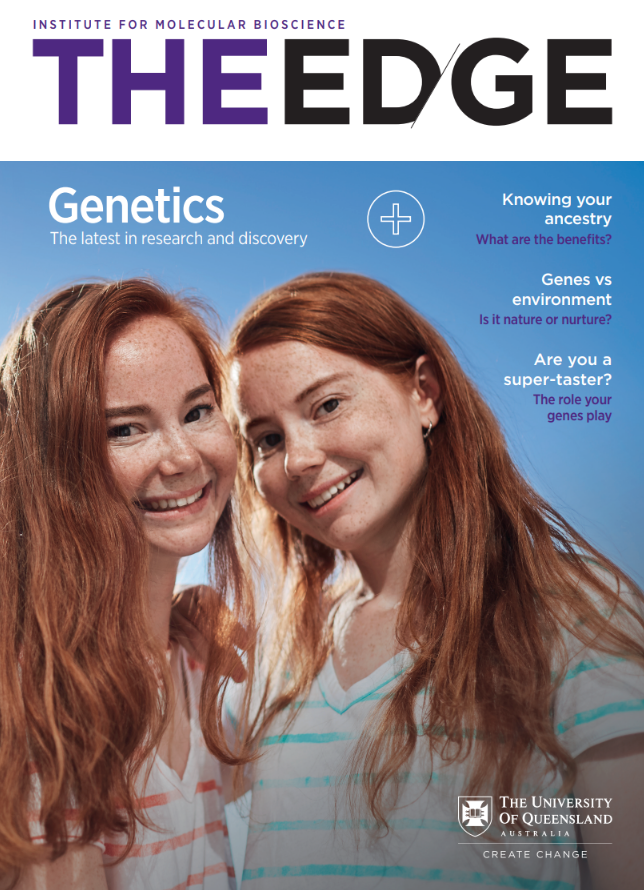


The Edge: Genetics

People have known for thousands of years that parents pass traits to their children, but it is only relatively recently that our technology has caught up to our curiosity, enabling us to delve into the mystery of how this inheritance occurs, and the implications for predicting, preventing and treating disease.

 View online
 Download magazine

Subscribe to our newsletter

Get the latest research straight to your inbox. 
Stay up-to-date as we answer questions about hot topics, and share the latest news at IMB, Australia’s #1 research institute.

Subscribe

General enquiries

  +61 7 3346 2222
  imb@imb.uq.edu.au

Media enquiries

IMB fully supports UQ's Reconciliation Action Plan and is implementing actions within our institute.
Support us

Donate to research
100% of donations go to the cause