

Get the latest research to your inbox
- Senior Research AssistantInstitute for Molecular Bioscience
White group
Group Leader
Dr Mel White
Senior Research FellowInstitute for Molecular BioscienceResearcher profile is public:1Supervisor:Researcher biography:Dr Melanie White heads the Dynamics of Morphogenesis Lab at the Institute for Molecular Bioscience (IMB), University of Queensland and is an ARC Future Fellow. She completed a PhD in Neuroscience at University College London followed by postdoctoral research at The University of Edinburgh. During this time Mel engineered viruses to modulate gene expression in the brain to investigate neuronal function and as a therapeutic approach for neurodegenerative disease. Her work was published in Neuron and PNAS, featured in Nature Reviews Neuroscience and received extensive international media coverage (including the BBC and The Guardian).
In 2012 Mel switched fields to apply quantitative imaging in developmental biology. Her work revealed key mechanisms driving the earliest morphogenetic events in mammalian embryogenesis and was published in Cell, Science, Nature Cell Biology, Developmental Cell and Nature Protocols. Her research was featured on the cover of multiple journals including Cell and she was awarded the inaugural American Society for Cell Biology Porter Prize for Research Excellence (2018).
In 2020, Mel joined the IMB where she will combine her passion for neuroscience and developmental biology to investigate the dynamics of neural tube morphogenesis.
Research overview
The brain and the spinal cord control most of the functions of the body and the mind, yet the dynamics of how they first form is poorly understood. Both structures arise from a common precursor, the neural tube, which forms very early in embryonic development. To generate the forces that sculpt and shape the neural tube, changes in cellular architecture must be tightly coordinated in space and time. These morphological rearrangements occur concurrently with biochemical signalling pathways that specify early neural cell fates.
Our research aims to understand how cellular properties and transcriptional regulators interact with mechanical forces in real time to direct vertebrate neural tube formation and neural cell fate specification. We study the dynamics of neural tube formation by applying advanced imaging technologies in transgenic avian models and human stem cell models.
Body:Highlights
The use of high-spatiotemporal resolution live imaging has enabled us to discover and characterize new cellular structures essential for early embryo development. Firstly, we revealed the existence of long filopodia that form in some cells of the preimplantation mouse embryo and stretch out over their neighbors to facilitate the crucial process of embryo compaction (Nature Cell Biology, 2013). I also contributed to work characterizing a non-centrosomal microtubule organising centre that directs intracellular transport of adhesion molecules in the embryo (Science, 2017). Most recently, I discovered rings of actin filaments that form on apical cell surfaces of the mouse embryo and expand to the cell junctions just prior to blastocyst formation (Cell, 2018). We showed that coupling of these rings to the junctions triggers a tension-dependent zippering process that seals the embryo and allows expansion of the first cavity.
The development of an embryo requires a series of cell fate decisions to produce all the future cells of the body and extraembryonic tissues. Deciphering the mechanisms controlling cell fate determination is important not only to understand embryonic development, but also to provide advances in stem cell reprograming and regenerative medicine. My research has provided important insights into when and how cell fate bias first arises in the embryo and the mechanisms that drive the physical separation of the first cell lineages. By applying fluorescence correlation spectroscopy in the living embryo, we measured the binding dynamics of fate-specifying transcription factors (TF) in individual cells and revealed how differences in histone methylation affect TF dynamics to bias cell fate (Cell, 2016). Using 4D cell segmentation and computational tracking and laser-based ablations, we demonstrated that subcellular heterogeneities in tensile forces drive the first spatial segregation of cells in the embryo (Developmental Cell, 2015).
Connect




Researchers
Dr Yanina Alvarez
Research Fellow/Senior Research officer & Deputy Lab Head, White LabInstitute for Molecular BioscienceResearcher profile is public:1Supervisor:Dr Siew Zhuan Tan
Research AssistantInstitute for Molecular BioscienceResearcher profile is public:0Supervisor:Mr Jianxiong Wang
Postdoctoral Research FellowInstitute for Molecular BioscienceResearcher profile is public:1Supervisor:PhD Students
Mrs Marise van der Spuy
PhD Student & Casual Research Assistant & Research OfficerInstitute for Molecular BioscienceResearcher profile is public:0Supervisor:Dr Amber Driessen
PhD Student & Postdoctoral Research FellowInstitute for Molecular BioscienceResearcher profile is public:0Supervisor:Miss Samara Ranie
PhD StudentInstitute for Molecular BioscienceResearcher profile is public:0Supervisor:Mr Marius Predel
PhD StudentInstitute for Molecular BioscienceResearcher profile is public:1Supervisor:Miss Murron Carroll
PhD StudentInstitute for Molecular BioscienceResearcher profile is public:0Supervisor:Miss Tianyang Zhang
PhD StudentInstitute for Molecular BioscienceResearcher profile is public:1Supervisor:- PhD studentInstitute for Molecular Bioscience
- Human Resources Business PartnerInstitute for Molecular Bioscience
- Higher degree by research (PhD) studentInstitute for Molecular Bioscience
- PhD StudentInstitute for Molecular Bioscience
- PhD studentInstitute for Molecular Bioscience
Pages
Strawberry DNA extraction activity
Extract and view DNA from a strawberry using common household ingredients.
Get started
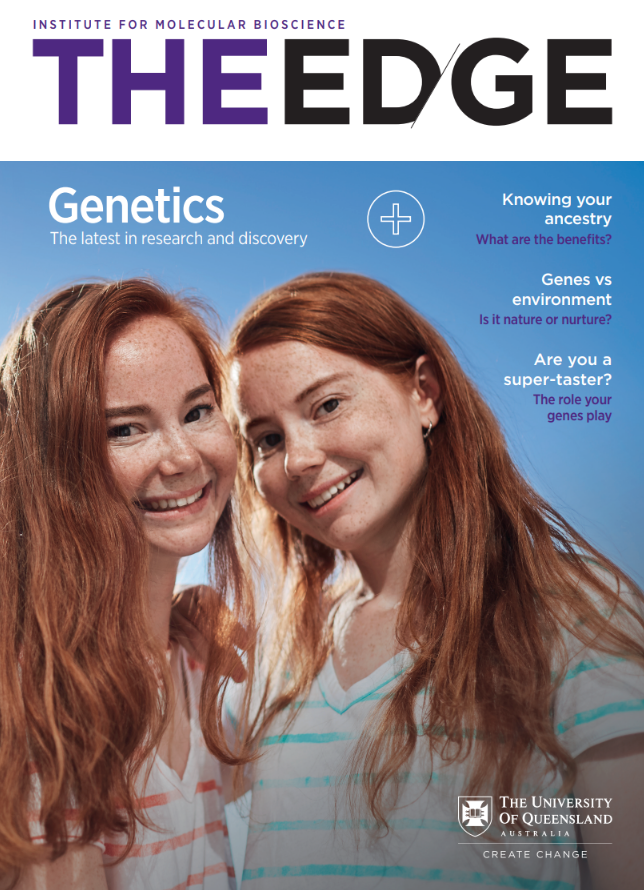
The Edge: Genetics
People have known for thousands of years that parents pass traits to their children, but it is only relatively recently that our technology has caught up to our curiosity, enabling us to delve into the mystery of how this inheritance occurs, and the implications for predicting, preventing and treating disease.
Subscribe to our newsletter
Get the latest research straight to your inbox.
Stay up-to-date as we answer questions about hot topics, and share the latest news at IMB, Australia’s #1 research institute.
General enquiries
+61 7 3346 2222
imb@imb.uq.edu.au
Media enquiries
IMB fully supports UQ's Reconciliation Action Plan and is implementing actions within our institute.

Support us
Donate to research
100% of donations go to the cause