

Get the latest research to your inbox
- Postdoctoral Research Fellow & Research Fellow/Senior Research officerInstitute for Molecular Bioscience
Doolan Group
Group Leader
Professor Denise Doolan
Professorial Research Fellow & Group Leader & Deputy Director (Research)Institute for Molecular BioscienceResearcher profile is public:1Supervisor:Researcher biography:Professor Denise Doolan is Director of Research at the Institute for Molecular Bioscience. She joined IMB in 2022 and was previously Deputy Director of the Australian Institute of Tropical Health and Medicine, and Director of the JCU Centre for Molecular Therapeutics, at James Cook University.
She is a molecular immunologist, working on the development of vaccines, diagnostics and host-directed therapeutics for infectious and chronic diseases that impact global public health, with a particular focus on malaria. Her cross-disciplinary research program spans host-pathogen immunity, antigen discovery, vaccine engineering, and biomarker discovery. A particular interest is the application of state-of-the-art genome-based technologies and human models of disease system to identify novel targets for intervention against disease or that predict risk of disease.
She is a recognized world expert in malaria immunology, vaccinology, and omic-based approaches for therapeutic and diagnostic development. She has been honoured as a Fellow of the International Society for Vaccines (2017) and a Fellow of the Australian Society of Parasitology (2019) in recognition of her leadership and contribution to health and medical science in Australia and internationally.
Professor Doolan serves on a number of Executive Boards and Advisory Boards. Most recently, she has been elected as President of the International Society for Vaccines (2021-2023), and has been appointed to the Federal Government's Australian Medical Research Advisory Board (AMRAB; 2021-2026) to provide specialist insights into Australia's medical research and innovation priorities.
Body:
Researchers
Dr Yomani Sarathkumara
Postdoctoral Research FellowInstitute for Molecular BioscienceResearcher profile is public:1Supervisor:Researcher biography:Dr. Yomani Sarathkumara's research focuses on characterising humoral immune responses to Epstein-Barr virus (EBV) in EBV-associated diseases.
During her PhD at James Cook University, Australia, she identified novel antibody biomarkers for EBV-associated cancers, including natural killer/T-cell lymphoma and Hodgkin lymphoma, using well-characterised hospital-based case-control samples from the AsiaLymph study—a large, multicentre epidemiological investigation of lymphoma and related haematologic malignancies conducted across Asia in collaboration with the U.S. National Cancer Institute (NCI). She also identified antibody markers predictive of clinical responses in EBV-positive lymphoma patients treated with EBV-specific T-cell immunotherapy in Phase I clinical trials conducted by Baylor College of Medicine, USA.
Her Honours research at Northumbria University, UK, focused on identifying antibody responses to a fungal antigen associated with Pigeon Fancier's Lung disease. For her Master's by Research (MPhil) from 2016–2018, conducted in collaboration with the University of Peradeniya, Sri Lanka, and Hokkaido University, Japan, she demonstrated that hantavirus exposure is a major risk factor for developing chronic kidney disease of unknown aetiology (CKDu) in Sri Lanka—a significant public health concern in agricultural communities. This study earned the President's Award for Scientific Research - 2019 in Sri Lanka.
Following her PhD, Dr. Sarathkumara joined the University of Queensland (UQ) as a Postdoctoral Research Fellow under the supervision of Professor Denise Doolan. Building on her doctoral work, she is currently investigating the potential role of EBV in triggering autoimmune diseases such as multiple sclerosis (MS), aiming to identify diagnostic and predictive antibody biomarkers. This work is conducted in collaboration with the University of Texas and the Oklahoma Medical Research Foundation, USA. In parallel, she is also examining antibody responses in individuals with acute EBV infection through a collaboration with UMass Chan Medical School, University of Massachusetts, USA.
Her research integrates high-throughput serological profiling, statistical modelling, and immunoassay development, and is supported by strong international collaborations.
Dr Anouschka Akerman
Postdoctoral Research FellowInstitute for Molecular BioscienceResearcher profile is public:1Supervisor:Dr Ashton Kelly
Researcher profile is public:1Supervisor:Ms Maggie King
Principal Research AssistantInstitute for Molecular BioscienceResearcher profile is public:0Supervisor:Students
Ms Brenna Daily
PhD Student & Casual Senior Research AssistantInstitute for Molecular BioscienceResearcher profile is public:0Supervisor:Miss Nadia Boulahia
PhD StudentInstitute for Molecular BioscienceResearcher profile is public:0Supervisor:Miss Kiara Knuckey
StudentInstitute for Molecular BioscienceResearcher profile is public:1Supervisor:Capon Group
Group Leader
Professor Rob Capon
Professorial Research Fellow - GLInstitute for Molecular BioscienceResearcher profile is public:1Supervisor:Researcher biography:My research group specializes in the detection, isolation, identification and evaluation of biologically active small molecules from Nature (natural products). We acquire valuable knowledge on how and why natural products are made, and apply this knowledge to better understand living systems, and solve important scientific and societal challenges.
To achieve these goals we have established specialist capabilities that extend across;
Microbiology – the isolation, characterization and cultivation of bacterial and fungal strains.
Chemistry – the extraction and fractionation of natural extracts, the purification, chemical and spectroscopic characterization, and structure elucidation of natural products, and the use of synthetic and medicinal chemistry to explore bioactive scaffolds.
Biology – to evaluate extracts and natural products against an array of bioassays, leading to new human pharmaceuticals that target such indications as infectious and neurodegenerative diseases, cancer, pain and epilepsy, as well as new animal health products and new crop protection agents.
Body:Highlights
Professor Rob Capon is a natural products chemist. He is a master of interrogating the molecular diversity of the natural world and applying it to society’s most pressing social and economic problems. He goes out into the natural world, detects biologically active molecules from living things, then isolates, identifies and evaluates them. Most importantly, he is committed to finding a use for them. His mantra for commercialization is ‘forced failure', in other words, “if you can break it, you won’t make it”. With the enormous untapped potential of natural products, he doesn’t like to waste time. He works quickly to “break or make” hypotheses, to focus resources on those molecules that are worthy of investment.
Professor Capon leads a group of researchers that are responsible for assembling a world-class molecule library, which along with the Australian collection of microbes housed at IMB, is used to discover new drugs. For Professor Capon, the most rewarding aspect of his work is the ability to dip into the molecular resource in the Australian environment, extract the chemistry and use it to improve our understanding of the natural world, and solve important problems.
He applies his research methodology to human health, animal health, crop protection, and environmental protection. He collaborates broadly in each of these areas.
Video
Connect


Researchers
Dr Jianying Han
Research FellowInstitute for Molecular BioscienceResearcher profile is public:1Supervisor:Researcher biography:Jianying Han (PhD) is an Early Career Research Fellow and Natural Product Chemist at the Institute for Molecular Bioscience, specialising in the discovery of structurally novel and biologically active small molecules from unique microbial resources. His research focuses on unlocking the chemical diversity of underexplored microorganisms, particularly rare Actinobacteria and other environmentally derived microbes. Dr Han integrates microbial cultivation strategies, genome-guided discovery, and advanced chemical analysis to activate silent biosynthetic pathways and reveal new classes of natural products. His work employs innovative approaches including high-throughput cultivation matrices, co-cultivation, precursor-directed biosynthesis, and microbial biotransformation to expand the chemical space accessible from microbial metabolites. Through these strategies, He aims to identify new bioactive compounds with potential applications in agriculture, biotechnology, and pharmaceutical discovery, while contributing to the development of Australia's microbial resources and bioeconomy.
Ms Jolynn Kiong
Institute for Molecular BioscienceResearcher profile is public:0Supervisor:Dr Taizong Wu
Institute for Molecular BioscienceResearcher profile is public:0Supervisor:Dr Amila Agampodi Dewa
Postdoctoral Research FellowInstitute for Molecular BioscienceResearcher profile is public:1Supervisor:Students
Dr Thulasi Sritharan
PhD studentInstitute for Molecular BioscienceResearcher profile is public:1Supervisor:Ms Caitlin Aust
Global Challenges ScholarInstitute for Molecular BioscienceResearcher profile is public:0Supervisor:Dr Shengbin Jin
PhD student & Research OfficerInstitute for Molecular BioscienceResearcher profile is public:1Supervisor:Mr Jerry Guo
Masters StudentResearcher profile is public:1Supervisor:Ms Alvi Wardani
PhD studentInstitute for Molecular BioscienceResearcher profile is public:1Supervisor:Mr Dean Wu
Masters StudentInstitute for Molecular BioscienceResearcher profile is public:1Supervisor:Yuxuan Zhu
Masters StudentInstitute for Molecular BioscienceResearcher profile is public:1Supervisor:Xueqing Ding
Masters StudentInstitute for Molecular BioscienceResearcher profile is public:1Supervisor:- Our program is designed to create a cohort of outstanding researchers who use multidisciplinary approaches to discover the cellular basis of chronic diseases, enabling us to develop future disease therapies.
- Postdoctoral Research FellowInstitute for Molecular Bioscience
- Discover new medicines from nature with a PhD top-up scholarship from Australia’s top-ranked institute.
- Research OfficerInstitute for Molecular Bioscience
- How a handful of dirt can prevent a looming global health crisis.
- Postdoctoral Research FellowInstitute for Molecular Bioscience
Pages
Strawberry DNA extraction activity
Extract and view DNA from a strawberry using common household ingredients.
Get started
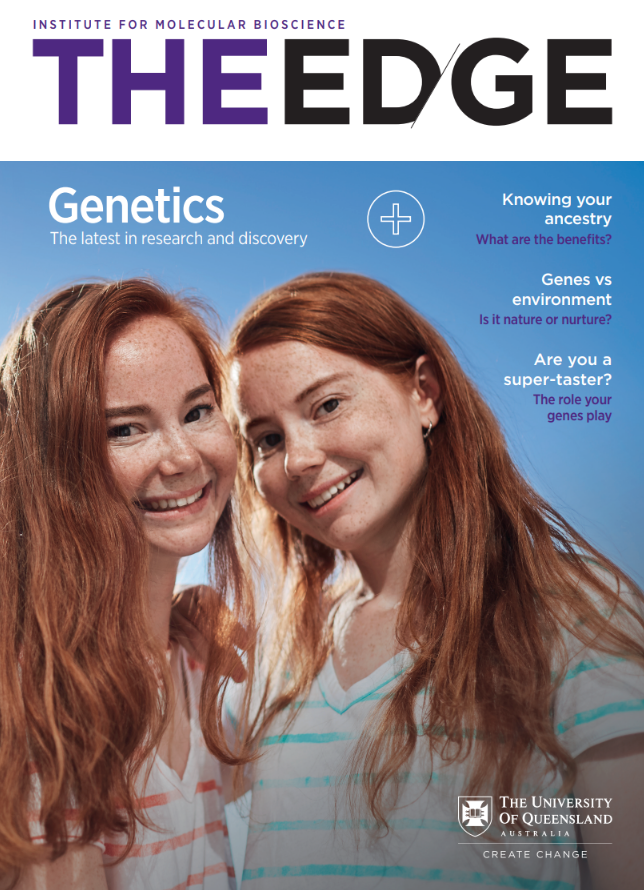
The Edge: Genetics
People have known for thousands of years that parents pass traits to their children, but it is only relatively recently that our technology has caught up to our curiosity, enabling us to delve into the mystery of how this inheritance occurs, and the implications for predicting, preventing and treating disease.
Subscribe to our newsletter
Get the latest research straight to your inbox.
Stay up-to-date as we answer questions about hot topics, and share the latest news at IMB, Australia’s #1 research institute.
General enquiries
+61 7 3346 2222
imb@imb.uq.edu.au
Media enquiries
IMB fully supports UQ's Reconciliation Action Plan and is implementing actions within our institute.
Support us
Donate to research
100% of donations go to the cause