
Get the latest research to your inbox
Wray/Visscher Group
Group Leaders
Professor Peter Visscher
UQ Laureate Fellow and Group LeaderInstitute for Molecular BioscienceResearcher profile is public:1Supervisor:Researcher biography:Visscher joined the University of Queensland in 2011, where he is Professor of Quantitative Genetics. He is a Laureate Fellow of the Australian Research Council. Visscher was elected a Fellow of the Australian Academy of Science in 2010, a Fellow of the Royal Society (London) in 2018 and a Foreign Member of the Royal Netherlands Academy of Arts and Sciences in 2018.
Visscher’s research is about genetic variation for complex traits (including quantitative traits and disease) in populations, with the broad aim to understand and quantify the causes and consequences of human trait variation.
Prof Peter Visscher, Prof Naomi Wray and Prof Jian Yang together comprise the Executive Team of the Program in Complex Trait Genomics (PCTG). PCTG comprises a critical mass of more than 30 post-doctoral researchers plus research assistants and students, all supported by external grant funding. Their skills lie in the ability to develop and apply statistical methods within the framework of quantitative, population and statistical genetics and to use theory to understand and predict results from data analyses. They play leading roles in the international research consortia. The focus of current research activities is in the detection and fine-mapping of loci underlying complex traits (including common disease), based upon theoretical studies and applications of methods to large datasets, in population genetics studies using theoretical approaches and high-density genetic marker data, and in systems genomics studies.
Professor Naomi Wray
Joint AppointmentQueensland Brain InstituteProfessorial Research FellowInstitute for Molecular BioscienceResearcher profile is public:1Supervisor:Researcher biography:Naomi Wray is the Michael Davys Professor in the Department of Psychiatry, University of Oxford. She holds an appointment at the Institute for Molecular Bioscience (IMB) within the University of Queensland. She joined UQ Queensland Brain Institute in 2011 moving to the IMB in 2015. She was Head of the Centre for Population & Disease Genomics within IMB 2018-2023. Her Oxford appointment started in 2023.
Her research focuses on development and application of quantitative genetics and genomics methodologies across complex diseases, disorders and traits, but particularly psychiatric-related traits.
She is a National Health and Medical Research Council (NHMRC) Leadership Fellow, a Fellow of the Australian Academy of Science and a Fellow of the Australian Academy of Health and Medical Science. In 2020 she was awarded the NHMRC Elizabeth Blackburn Award for Leadership in Basic Science and the 2021 International Society of Psychiatric Genetics Ming Tsuang Lifetime Achievement Award. She is a Clarivate Highly Cited researcher.
She was Director of the Program in Complex Trait Genomics (PCTG) funded as an NHMRC Program Grant 2017-2022. She plays a key role in the International Psychiatric Genomics Consortium and established the sporadic ALS Australia systems genomics consortium (SALSA) funded by the MND Research Australia IceBucket Challenge and FightMND. She is a co-investigator on the Australian Genetics of Depression Study (AGDS) and is currently launching the AGDS-Cello project focussed on establishing a cell line resource from participants with a detailed history of anti-depressant use and response measures. She is part of an NHMRC Synergy (2023-2027) "Rhythms and blues: Personalising care for body clock dysfunction in mood disorders".
She is secretary of the International Society of Psychiatric Genetics, and is on the editorial advisory boards of JAMA Psychiatry, Neuron, Royal Society Open and Research Directions: Depression.
Researchers
Dr Yang Wu
Higher degree by research (PhD) studentInstitute for Molecular BioscienceResearcher profile is public:1Supervisor:Dr Jian Zeng
NHMRC Emerging Leadership Fellow & Group LeaderInstitute for Molecular BioscienceResearcher profile is public:1Supervisor:Researcher biography:Dr Jian Zeng is a statistical geneticist and NHMRC Emerging Leadership Fellow at the Institute for Molecular Bioscience (IMB) at the University of Queensland (UQ). He received his PhD in animal breeding and genetics at Iowa State University and joined the Program in Complex Trait Genomics (PCTG) at UQ in 2016. His research focuses on the development and application of innovative statistical methods for estimating the genetic architecture and evolutionary signals in complex traits, identifying genetic variants, genes and other molecular intermediates associated with phenotype variation, and predicting trait phenotypes using genome sequence data. In 2019, he was awarded an NHMRC Investigator Emerging Leadership Grant to develop statistical methods and software tools for best predict an individual's disease risk using genomic and omics data. He was an invited speaker at the prestigious Gordon Research Conference in 2019.
Students
Dr Alesha Hatton
Postdoctoral Research FellowInstitute for Molecular BioscienceResearcher profile is public:1Supervisor:Researcher biography:Alesha Hatton is a postdoctoral research fellow specializing in statistical genetics and genetic epidemiology at the Institute for Molecular Bioscience, University of Queensland. Currently, her research focuses on understanding the genetic and environmental aetiology underlying complex traits through use of Mendelian randomization and statistical genetics methodologies. Her PhD was in systems genomics, applying quantitative genetics methods to investigate the role of DNA methylation in complex trait variation. Alesha has a bachelor's degree in medical mathematics from the University of Wollongong and previously was employed as a statistician at the South Australian health and Medical Research Institute.
Mr Longda Jiang
Higher degree by research (PhD) studentInstitute for Molecular BioscienceResearcher profile is public:0Supervisor:Mr Restu Restuadi
Higher degree by research (PhD) studentInstitute for Molecular BioscienceResearcher profile is public:1Supervisor:Mr Pierrick Wainschtein
Adjunct FellowInstitute for Molecular BioscienceResearcher profile is public:0Supervisor:Ms Ying Wang
Higher degree by research (PhD) studentInstitute for Molecular BioscienceResearcher profile is public:0Supervisor:Miss Shiane Groot
PhD studentInstitute for Molecular BioscienceResearcher profile is public:1Supervisor:Admin Support Staff
Research Support Staff
Mr Angli Xue
Institute for Molecular BioscienceResearcher profile is public:1Supervisor:Tags:Wray/Visscher Group- Adjunct Associate ProfessorInstitute for Molecular Bioscience
- PhD StudentInstitute for Molecular Bioscience
- Honorary Associate ProfessorInstitute for Molecular Bioscience
- Honorary FellowInstitute for Molecular Bioscience
- Honorary Associate ProfessorInstitute for Molecular Bioscience
- Masters Student
Vetter Group
Group Leader
Professor Irina Vetter
Director for Higher Degree Research & NHMRC Leadership Fellow & Group LeaderInstitute for Molecular BioscienceResearcher profile is public:1Supervisor:Researcher biography:I am an NHMRC Leadership Fellow with joint apointments at the Institute for Molecular Bioscience (IMB) and School of Pharmacy, UQ. My research interests lie in the fields of peripheral pain mechanisms, target identification and analgesic drug discovery. I investigate the contribution of ion channels to sensory neuronal physiology using highly subtype-selective toxins isolated from venomous animals with the aim to develop novel analgesics with improved efficacy and tolerability.
Body:Highlights
Associate Professor Irina Vetter has a strong background in neuropharmacology, pain models, toxinology and high-throughput screening. Currently her primary research interests lie in the fields of peripheral pain mechanisms, target identification, biodiscovery of venom peptide ion channel modulators and analgesic drug discovery.
Associate Professor Vetter has always been fascinated by how we perceive the world around us, in particular, the role of sensory neurons in the body. Sensory neurons are an intricate network of nerve cells that convert external stimuli from the environment into messages within the body, like pain. Her research is demystifying the different pathways that contribute to pain in various disease states. She is using biomedical research and pharmacology to develop pain treatments from venoms and toxins.
Associate Professor Vetter is an ARC Future Fellow and Deputy Director of the Centre for Pain Research at The University of Queensland. She is a registered pharmacist and has worked in hospital as well as community pharmacy. She obtained her PhD in 2007 from the School of Pharmacy, and conducted postdoctoral studies as an NHMRC postdoctoral fellow under Prof Geoffrey Goodhill at the Queensland Brain Institute and under Prof Richard J Lewis at the Institute for Molecular Bioscience in the areas of axon guidance and venom peptide pharmacology
Video
Connect


Researchers
Dr Hana Starobova
Higher degree by research (PhD) student & NHMRC Emerging Leadership FellowInstitute for Molecular BioscienceResearcher profile is public:1Supervisor:Researcher biography:Dr Hana Starobova is a pharmacist and NHMRC research fellow at the Sensory Neuropharmacology Group at the University of Queensland (UQ). She works under the mentorship of Prof. Vetter, and as an early career researcher, she is working toward an independent research career as a group leader. She obtained her PhD in 2020 from the Institute for Molecular Bioscience, UQ, and continued here to conduct studies as a Children Hospital Foundation Fellow (2021-2023) in the areas of cancer therapy-induced adverse and late effects with the main focus on neuropathies. Over the past four years, she has developed a research program focusing on the understanding of cancer therapy-induced adverse and late effects with a special interest in children, and established innovative transcriptomic and microscopy pipelines, in vitro assays, adult and juvenile models of adverse and late effects following mono- and combination chemotherapy and radiotherapy, assays for the assessment of adverse effects including cognition and neuropathies, as well as cancer models. Knowledge impact arising from her research program has been disseminated in 18 peer-reviewed publications, having together attracted >1,100 citations (h-index 15, i10-index 18, Google Scholar, May 2024).
Mr Theo Crawford
Visiting ResearcherInstitute for Molecular BioscienceResearcher profile is public:0Supervisor:Dr Vanessa Schendel
Postdoctoral Research FellowInstitute for Molecular BioscienceResearcher profile is public:1Supervisor:Mr Ben Cristofori-Armstrong
Higher degree by research (PhD) studentResearcher profile is public:0Supervisor:Ms Thi Ngoc Hue Tran
Researcher profile is public:1Supervisor:Students
Ms Wanlin Chen
Researcher profile is public:0Supervisor:Ms Naiqi Shi
Researcher profile is public:0Supervisor:Mr Ammar Alshammari
PhD studentInstitute for Molecular BioscienceResearcher profile is public:1Supervisor:Miss Priyaa Purushotham Vasan
Researcher profile is public:1Supervisor:Ms Svetlana Shatunova
PhD studentInstitute for Molecular BioscienceResearcher profile is public:1Supervisor:Miss Nicolette Tay
PhD studentInstitute for Molecular BioscienceResearcher profile is public:1Supervisor:Ms Ashvriya Thapa
PhD studentInstitute for Molecular BioscienceResearcher profile is public:1Supervisor:Ms Lucinda Walker
Global Challenges ScholarInstitute for Molecular BioscienceResearcher profile is public:0Supervisor:
Pages
Strawberry DNA extraction activity
Extract and view DNA from a strawberry using common household ingredients.
Get started
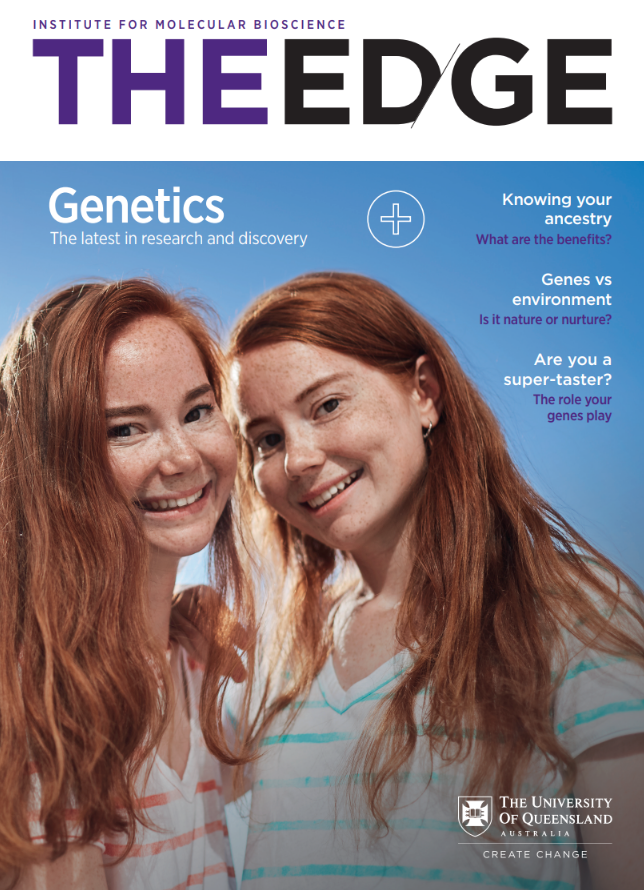
The Edge: Genetics
People have known for thousands of years that parents pass traits to their children, but it is only relatively recently that our technology has caught up to our curiosity, enabling us to delve into the mystery of how this inheritance occurs, and the implications for predicting, preventing and treating disease.
Subscribe to our newsletter
Get the latest research straight to your inbox.
Stay up-to-date as we answer questions about hot topics, and share the latest news at IMB, Australia’s #1 research institute.
General enquiries
+61 7 3346 2222
imb@imb.uq.edu.au
Media enquiries
IMB fully supports UQ's Reconciliation Action Plan and is implementing actions within our institute.

Support us
Donate to research
100% of donations go to the cause


