
Get the latest research to your inbox
Centre Directors
Professor Brett Collins
Director, Centre for Cell Biology of Chronic DiseaseNHMRC Leadership Fellow - GL & Centre Director of Institute for Molecular BioscienceInstitute for Molecular BioscienceResearcher profile is public:1Supervisor:Researcher biography:Brett Collins is an NHMRC Career Development Fellow and head of the Molecular Trafficking Lab at UQ's Institute for Molecular Bioscience. He was a lead investigator in the seminal structural studies of AP2, the protein adaptor molecule central to clathrin-mediated endocytosis, and has since defined the molecular basis for the function of critical proteins regulating membrane trafficking and signalling at the endosome organelle. His team is now focused on understanding how discrete molecular interactions between proteins and lipids control these processes in human cells.
Associate Professor Collins was awarded his PhD in 2001 and has published over 75 papers including in Cell, Nature, Nature Structural and Molecular Biology, Developmental Cell, and The Proceedings of the National Academy of Sciences USA, altogether cited more than 3100 times. He is the recipient of 3 prestigious fellowships, including a previous Career Development Award from the National Health and Medical Research Council and a Future Fellowship from the Australian Research Council, and was awarded the University of Queensland Research Excellence Award in 2008. In 2015 he was awarded the Emerging Leader Award of the ANZSCDB and in 2016 the Merck Research Medal from the ASBMB. He is currently the President of the Queensland Protein Group.
Body:Highlights
Seeing the structure of a protein at the atomic level as an undergrad set off a career in structural biology for Brett Collins. His interest in how cells work, and the techniques used to visualise the complex interaction mechanisms of the structures within, earned him his PhD in 2001. Postdoctorate work at Cambridge University steered him towards ‘membrane trafficking’, the term used to describe how proteins are moved from one part of a cell to another, or indeed between cells, via a complex system of membranes.
Now, as head of IMB’s Membrane Trafficking Group, he’s using techniques such as X-ray crystallography and cryo-electron microscopy to visualise protein structure at the atomic level to investigate why things sometimes go wrong with our cells’ protein transport system. Faulty proteins are known to cause the development of neurodegenerative conditions such as Parkinson’s and Alzheimer’s disease, and muscular dystrophy.
Connect


Professor Ben Hankamer
Professorial Research Fellow and Director, Centre for Chemistry and Drug DiscoveryInstitute for Molecular BioscienceResearcher profile is public:1Supervisor:Researcher biography:Centre for Solar Biotechnology: Prof Ben Hankamer is the founding director of the Solar Biofuels Consortium (2007) and Centre for Solar Biotechnology (2016) which is focused on developing next generation microalgae systems. These systems are designed to tap into the huge energy resource of the sun (>2300x global energy demand) and capture CO2 to produce a wide-range of products. These include solar fuels (e.g. H2 from water, oil, methane and ethanol), foods (e.g. health foods) and high value products (e.g. vaccines produced in algae). Microalgae systems also support important eco-services such as water purification and CO2 sequestration. The Centre is being launched in 2016/2017 and includes approximately 30 teams with skills ranging from genome sequencing through to demonstration systems optimsation and accompanying techno-economis and life cycle analysis. The Centre teams have worked extensively with industry.
Structural Biology: The photosynthetic machinery is the biological interface of microalgae that taps into the huge energy resource of the sun, powers the biosphere and produces the atmospheric oxygen that supports life on Earth. My team uses high resolution single particle analysis and electron tomography to solve the intricate 3D architecture of the photosynthetic machinery to enable structure guided design of high efficiency microalgae cell lines and advanced artificial solar fuel systems.
Body:Highlights
Professor Ben Hankamer trained in applied biochemistry in Liverpool before exploring his interest in the development of environmental solutions to re-green deserts at the Desert Research Centre in Israel.
He has a keen interest in environmental protection and climate change. He completed his Masters in plant biotechnology at Wye College, London University before completing his PhD in structural biology. He wanted to understand how plants catch the sunlight and CO2 and use these to produce the food, fuel and atmospheric oxygen which supports life on Earth. He discovered his research passion listening to a talk at the Royal Society in London on using algae to make hydrogen fuel from light and water, and it has been a major research focus ever since.
The Centre for Solar Biotechnology that he now directs develops advanced algae technologies for the production fuels, foods as well as a range of high value products including peptide therapeutics.
He was a recipient of an Eisenhower Fellowship, which allowed him to travel to the United States for seven weeks and engage with 2-3 industry partners per day. He is now the Director of the Centre for Solar Biotechnology at UQ's Institute for Molecular Bioscience.
His research focus is solar biotechnology and structural biology. He is designing high-efficiency microalgae systems to capture solar energy and CO2 to make a range of products including food and fuel. By expanding our photosynthetic capacity on non-arable land, he believes we can harness the Sun's energy to fuel the world ‘s future energy needs.
Video
Connect


Professor David Evans
Professorial Research Fellow and Director, Centre for Population and Disease GenomicsInstitute for Molecular BioscienceResearcher profile is public:1Supervisor:Researcher biography:David Evans is an NHMRC Leadership Fellow and Professor of Statistical Genetics at the University of Queensland Institute for Molecular Bioscience. He is a winner of the NHMRC Marshall and Warren Award.
He completed his PhD in Statistical Genetics at the University of Queensland in 2003, before undertaking a four-year post-doctoral fellowship at the Wellcome Trust Centre for Human Genetics, University of Oxford where he worked as part of the The International HapMap Consortium and co-led the analysis of four diseases within the first Wellcome Trust Case Control Consortium. In 2007 he moved to take up a Senior Lecturer position at the University of Bristol where he led much of the genome-wide association studies work in the Avon Longitudinal Study of Parents and Children (ALSPAC). In 2013 he returned to take up a chair at the University of Queensland whilst continuing to lead an MRC Programme in statistical genetics at the University of Bristol.
His research interests include the genetic mapping of complex traits and diseases (including birthweight and other perinatal traits, osteoporosis, ankylosing spondylitis, sepsis, laterality) and the development of statistical methodologies in genetic epidemiology including approaches for gene mapping, individual risk prediction, causal modelling and dissecting the genetic architecture of complex traits. He has a particular interest in Mendelian randomization and has used it and other causal methods to investigate the Developmental Origins of Health and Disease (DOHaD)- the idea that adverse intrauterine exposures lead to increased risk of disease in later life.
He is Academic Codirector at the NIH funded International Workshop on Statistical Genetics Methods and is faculty on the European Programme in Educational Epidemiology.
He is Associate Editor at the International Journal of Epidemiology and Behavior Genetics journals.
Professor Mark Schembri
Centre Director of Institute for Molecular Bioscience & Professorial Research Fellow & Group LeaderInstitute for Molecular BioscienceResearcher profile is public:1Supervisor:Researcher biography:Professor Mark Schembri is a prominent microbiologist with experience in combating the global health crisis presented by multi-drug resistant pathogens. Professor Schembri's expertise on the virulence of bacterial pathogens and his innovative analysis of biofilm formation aims to improve the outcomes of the >400 million individuals that suffer from urinary tract infections each year across the globe.
Through the application of genetic, genomic and functional studies on uropathogenic E. coli, Professor Schembri has identified targets to reduce the virulence of this pathogen, and will pursue the development of life-saving therapeutic and preventative advances with the assistance of NHMRC, MRFF and ARC grants. Professor Schembri has tracked the rapid emergence and global spread of a virulent, drug-resistant E. coli clone and used genome sequencing to understand its evolution and virulence.
Links: Professor Schembri collaborates with national and international research leaders, including in Denmark, where he was a lecturer. Professor Schembri has strong links with other international experts in his field, including at the Pasteur Institute and the Wellcome Trust Sanger Institute in Cambridge. His research collaborations also span lead groups at UQ and other top Australian institutes, including Griffith and La Trobe Universities.
Membership, Funding and patents: Since 2014, Professor Schembri has been awarded over $15 million in funding from competitive national research funding bodies. He holds provisional patents for the development of novel therapeutic agents and vaccine antigens. He is a Fellow of the American Academy of Microbiology, and is regularly invited to speak at international conferences in his field.
Awards and Communication: Professor Schembri was the recipient of the Frank Fenner Award (2010) and the ASM BacPath Oration Award (2019) for his outstanding original research contribution to the study of Infectious Disease. He was an Australian Research Council Future Fellow (2011-2015) a National Health and Medical Research Council Senior Research Fellow (2016-2020). Professor Schembri is the author of >240 peer-reviewed research manuscripts. He is President of the Australian Society for Microbiology (2022-2026).
- Research AssistantInstitute for Molecular Bioscience
- Higher degree by research (PhD) student & Postdoctoral Research Fellow/Research OfficerInstitute for Molecular Bioscience
- Higher degree by research (PhD) studentInstitute for Molecular Bioscience
- Senior Research FellowInstitute for Molecular Bioscience
- Professorial Research FellowNHMRC Leadership FellowInstitute for Molecular Bioscience
- PhD studentInstitute for Molecular Bioscience
Pages
Strawberry DNA extraction activity
Extract and view DNA from a strawberry using common household ingredients.
Get started
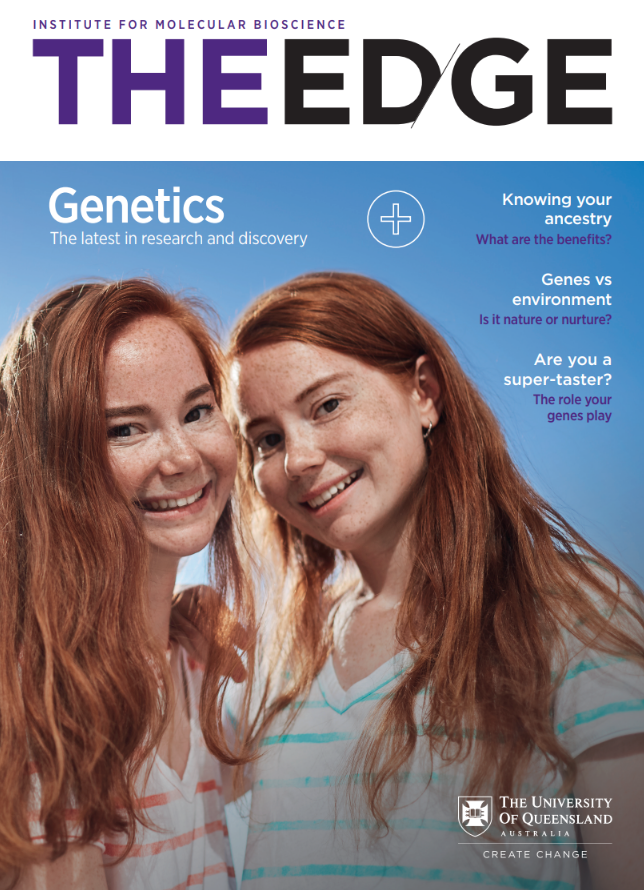
The Edge: Genetics
People have known for thousands of years that parents pass traits to their children, but it is only relatively recently that our technology has caught up to our curiosity, enabling us to delve into the mystery of how this inheritance occurs, and the implications for predicting, preventing and treating disease.
Subscribe to our newsletter
Get the latest research straight to your inbox.
Stay up-to-date as we answer questions about hot topics, and share the latest news at IMB, Australia’s #1 research institute.
General enquiries
+61 7 3346 2222
imb@imb.uq.edu.au
Media enquiries
IMB fully supports UQ's Reconciliation Action Plan and is implementing actions within our institute.
Support us
Donate to research
100% of donations go to the cause


