
IMB's latest news, explainers and more


Supporting life-saving research at CCRG

Read more

Get the latest research to your inbox

Subscribe
 

  • PhD student
    Institute for Molecular Bioscience
  • Francois Group

      Group Leader

    Dr Mathias Francois

    Group Leader, Genomics of Development and Disease Division
    Researcher profile is public: 
    0
    Supervisor: 
    Body: 

    Highlights

    After finishing his undergraduate degree at the Toulouse III University, Mat Francois undertook a PhD in Paris, studying the role of nuclear receptors in the control of inflammation associated with osteoarthritis, finishing in 2004.

    In 2005 he moved to Australia as a postdoctoral scientist in Peter Koopman’s laboratory, and began researching the role of SOX transcription factors in the control of lymphatic vessel development. His research led to the discovery of a molecular switch (SOX18) responsible for triggering the development of the lymphatic vascular system in the embryo. This finding helped him to launch his independent career. He was awarded the ASMR Queensland Premier’s award in 2009 and a UQ Foundation Research Excellence Award in 2011.

    Late in 2011 Mat set up his own lab at IMB to focus on the molecular hierarchy that governs endothelial cell differentiation during embryogenesis, and later received a career development award to elucidate the role of SOX protein in the modulation of the lymphatic and blood vascular growth that controls both embryonic development and tumour metastasis.

    Mat’s research at IMB is now based on the combination of developmental biology and the use of pathophysiological models (e.g. cancer metastasis and lymphoedema) in combination with a drug discovery pipeline to identify novel therapeutic approaches to block cancer metastasis via the pharmacological manipulation of transcription factor activity.

    Connect


      Researchers

    Mrs Emmanuelle Frampton

    Principal Research Technician/Scientist/Engineer
    Institute for Molecular Bioscience
    Researcher profile is public: 
    0
    Supervisor: 
    Body: 

    Emmanuelle is a research assistant working in the Francois lab at UQ's Institute for Molecular Bioscience.

      Students

    Miss Keyi Jiang

    Higher degree by research (PhD) student
    Institute for Molecular Bioscience
    Researcher profile is public: 
    0
    Supervisor: 

    Miss Alex Mccann

    Higher degree by research (PhD) student
    Institute for Molecular Bioscience
    Researcher profile is public: 
    0
    Supervisor: 
    Body: 

    Alex is an Honours student in the Francois lab at UQ's Institute for Molecular Bioscience.

    Ms Siew Zhuan Tan

    Higher degree by research (PhD) student
    Institute for Molecular Bioscience
    Researcher profile is public: 
    1
    Supervisor: 
  • Emerita Professor
    Institute for Molecular Bioscience
  • Neuropeptides are protein-like signalling molecules that regulate many important physiological processes and behaviours
  • Student
    Institute for Molecular Bioscience
  • Internal Communications and Senior Executive Assistant
    Institute for Molecular Bioscience
  • Ragan Group

      Group Leader

    Emeritus Professor Mark Ragan

    Emeritus Professor
    Institute for Molecular Bioscience
    Researcher profile is public: 
    0
    Supervisor: 
    Body: 

    Highlights

    Mark Ragan is an Emeritus Professor at the Institute for Molecular Bioscience, The University of Queensland in Brisbane, Australia.

    He was founding Head of IMB's former Division of Genomics & Computational Biology (2000-2014), founding Director of the Australian Research Council (ARC) Centre of Excellence in Bioinformatics (2003-2015), and co-founder of QFAB Bioinformatics.

    Mark is a graduate of the University of Chicago (Biochemistry) and Dalhousie University (Biology). His 200+ peer-reviewed research publications in biochemistry, molecular biology, evolutionary biology, genomics, algorithmics, bioinformatics and computational biology have attracted more than 13500 citations.

    Core technologies in his research group (integration of large bioscience data, scalable algorithms on trees and networks, bioinformatic workflows, high-performance and data-centric computing) were applied to problems of genome sequencing and de novo assembly, comparative evolutionary genomics, and inference of biomolecular networks particularly in the coral reef symbiont Symbiodinium, and in targeting therapies against DNA damage repair networks in familial breast cancer.

    Mark was also involved in national and international infrastructure initiatives in genomics, computing, data and bioinformatics services.

    Video


    Connect

    ResearcherID Scopus Orcid
    Linkedin      
     

      Researchers

    Associate Professor Cheong Xin Chan

    Research Visitor
    Institute for Molecular Bioscience
    Researcher profile is public: 
    1
    Supervisor: 
    Researcher biography: 

    Dr Chan has a PhD in Genomics and Computational Biology from UQ. He underwent postdoctoral training at Rutgers University (USA) in algal genomics and evolution. He returmed to UQ in late 2011 as one of the inaugural Great Barrier Reef Foundation Bioinformatics Fellows.

    Dr Chan joined the School of Chemistry and Molecular Biosciences in 2020 as a group leader at the Australian Centre for Ecogenomics (ACE). His group uses advanced computational approaches to study genome evolution and develop scalable approaches for comparative genomics.

      Students

    Mr Timothy Stephens

    Higher degree by research (PhD) student
    Institute for Molecular Bioscience
    Researcher profile is public: 
    0
    Supervisor: 

    Mr Raul Gonzalez Pech

    Higher degree by research (PhD) student
    Institute for Molecular Bioscience
    Researcher profile is public: 
    0
    Supervisor: 

      Support staff

  • PhD Student
    Institute for Molecular Bioscience

Pages

Strawberry DNA extraction activity

Extract and view DNA from a strawberry using common household ingredients.

Get started
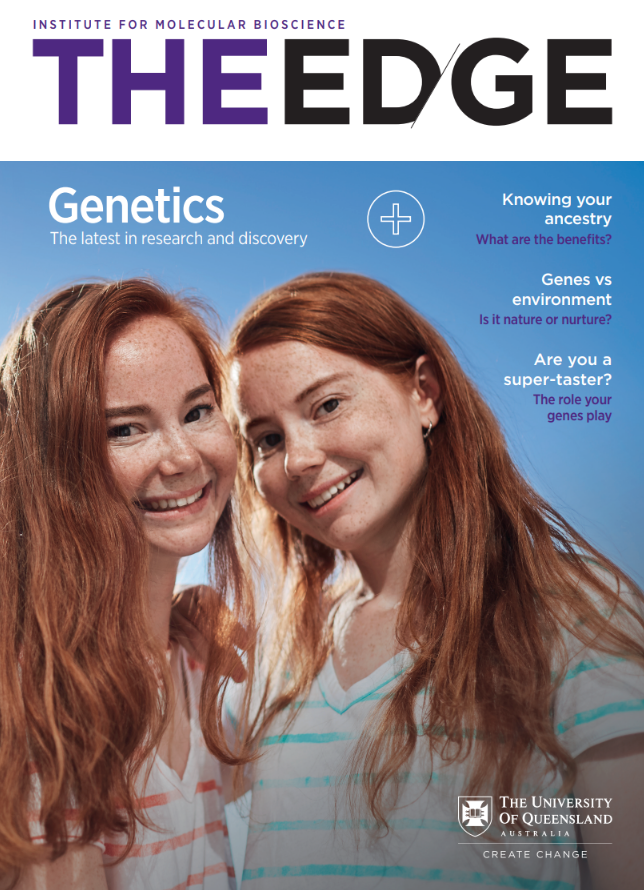


The Edge: Genetics

People have known for thousands of years that parents pass traits to their children, but it is only relatively recently that our technology has caught up to our curiosity, enabling us to delve into the mystery of how this inheritance occurs, and the implications for predicting, preventing and treating disease.

 View online
 Download magazine

Subscribe to our newsletter

Get the latest research straight to your inbox. 
Stay up-to-date as we answer questions about hot topics, and share the latest news at IMB, Australia’s #1 research institute.

Subscribe

General enquiries

  +61 7 3346 2222
  imb@imb.uq.edu.au

Media enquiries

IMB fully supports UQ's Reconciliation Action Plan and is implementing actions within our institute.
Support us

Donate to research
100% of donations go to the cause