

Get the latest research to your inbox
- What is the difference between a gene and a genome? And how do DNA, RNA and chromosomes fit into the picture?
- Postdoctoral Research FellowInstitute for Molecular Bioscience
- Research AssistantInstitute for Molecular Bioscience
Neavin Group
Group Leader
Dr Drew Neavin
Senior Research Fellow & Group LeaderInstitute for Molecular BioscienceResearcher profile is public:1Supervisor:Researcher biography:Dr Drew Neavin is an NHMRC Early Leadership Fellow and the Group Leader of the Context-dependent Genetics Lab at the University of Queensland Institute for Molecular Bioscience.
Drew integrates statistical genetics with stem cell platforms and single-cell technologies to expand our understanding of genetic regulation across different contexts. She helped establish "village-in-a-dish" stem cell systems that enable high-throughput stem cell culture while reducing technical variability by co-culturing induced pluripotent stem cell lines from hundreds of individuals in a single cell culture dish. She applies this system along with other experimental models to study genetic regulation. She works across multiple disease systems with focuses in neuopsychiatric and cardiac, with a special focus on genetic modulation of drug response. She is keen to build large-scale resources that enable population genetics interrogation that consider diversity across multiple different axes.
Researchers
Mr Benjamin Wu-Yang Khoo
Casual Senior Research AssistantInstitute for Molecular BioscienceResearcher profile is public:0Supervisor:Students
Ms Kate Topsfield
StudentInstitute for Molecular BioscienceResearcher profile is public:1Supervisor:Parton Group
Group Leader
Professor Robert Parton
Group Leader, Centre for Cell Biology of Chronic DiseaseARC Laureate Fellow - Group LeaderInstitute for Molecular BioscienceResearcher profile is public:1Supervisor:Researcher biography:Our research focuses on understanding how cells work and what goes wrong in disease. We are studying the role of cellular organelles in defence against pathogens, the molecular changes underlying muscle disease, and optimising methods to deliver therapeutics to specific cell types in whole animals.
Professor Robert Parton is an ARC Laureate Fellow, a group leader in the IMB Centre for Cell Biology of Chronic Disease, and Deputy Director of the Centre for Microscopy and Microanalysis. He is a Fellow of the Australian Academy of Science and an Associate Member of EMBO.
Body:Highlights
Professor Rob Parton studies cells - the building blocks of life. His unique methodology uses electron microscopy to create 3D models of cells, which he then explores interactively with virtual reality.
As a cell biologist, Professor Parton has always been fascinated by the cell and captivated by the beauty that visualising a cell through microscopy reveals. He is the only researcher using this technique. Following his degree in Scotland and PhD in England, he went on to participate in fundamental science at The European Molecular Biology Laboratory in Heidelberg, Germany. It was a pivotal chapter in his career.
He is best known for understanding how the plasma membrane of cells works, and particularly the crater-like indents in the cell membrane called Caveolae. By revealing how the cell structure works, and most importantly what goes wrong in disease, Professor Parton is identifying the drug targets of the future. The range of techniques that he uses, working at the cellular level right through to using animals in cell biology, sets his research apart.
Professor Parton is Chief Editor of Traffic and Associate Editor for Molecular Biology of the Cell. He is a Fellow of the Australian Academy of Science.
Videos
Connect


Researchers
Mr Charles Ferguson
Researcher profile is public:0Supervisor:Dr Tom Hall
Senior Research FellowInstitute for Molecular BioscienceResearcher profile is public:1Supervisor:Dr Ye-Wheen Lim
Higher degree by research (PhD) student & Postdoctoral Research FellowInstitute for Molecular BioscienceResearcher profile is public:1Supervisor:Dr Harriet Lo
Research FellowInstitute for Molecular BioscienceResearcher profile is public:1Supervisor:Mr Nick Martel
Research AssistantInstitute for Molecular BioscienceResearcher profile is public:0Supervisor:Dr Susan Nixon
Laboratory ManagerInstitute for Molecular BioscienceResearcher profile is public:0Supervisor:Mr James Rae
Researcher profile is public:0Supervisor:Dr Yeping Wu
Postdoctoral Research FellowInstitute for Molecular BioscienceResearcher profile is public:1Supervisor:Dr Thai Duong Luong
Postdoctoral Research FellowInstitute for Molecular BioscienceResearcher profile is public:1Supervisor:Dr Igor Bonacossa Pereira
Postdoctoral ScientistInstitute for Molecular BioscienceResearcher profile is public:1Supervisor:Researcher biography:Cells are the unit of life.
From the highly elongated neurons to the resilient and all enwrapping epithelial cells my work unravels a cell's structural building blocks, their repair tools and anti-infective arsenal.
My research aims at understanding the fundamental mechanisms by which cells maintain their integrity, fight infection and regulate their interface with the outside world, the membrane.
To study these elements I use a tiny roundworm called C. elegans as a model system and use precision gene editing, molecular biology, state-of-the-art microscopy and classical genetics.
Dr Dominic Hunter
Senior Research AssistantInstitute for Molecular BioscienceResearcher profile is public:0Supervisor:Students
Ms Le Nguyen
PhD StudentInstitute for Molecular BioscienceResearcher profile is public:1Supervisor:Mr Lucas Thor
PhD StudentInstitute for Molecular BioscienceResearcher profile is public:1Supervisor:Ms Navia John
PhD StudentInstitute for Molecular BioscienceResearcher profile is public:0Supervisor:Miss Haolan Sun
PhD StudentInstitute for Molecular BioscienceResearcher profile is public:0Supervisor:
Pages
Strawberry DNA extraction activity
Extract and view DNA from a strawberry using common household ingredients.
Get started
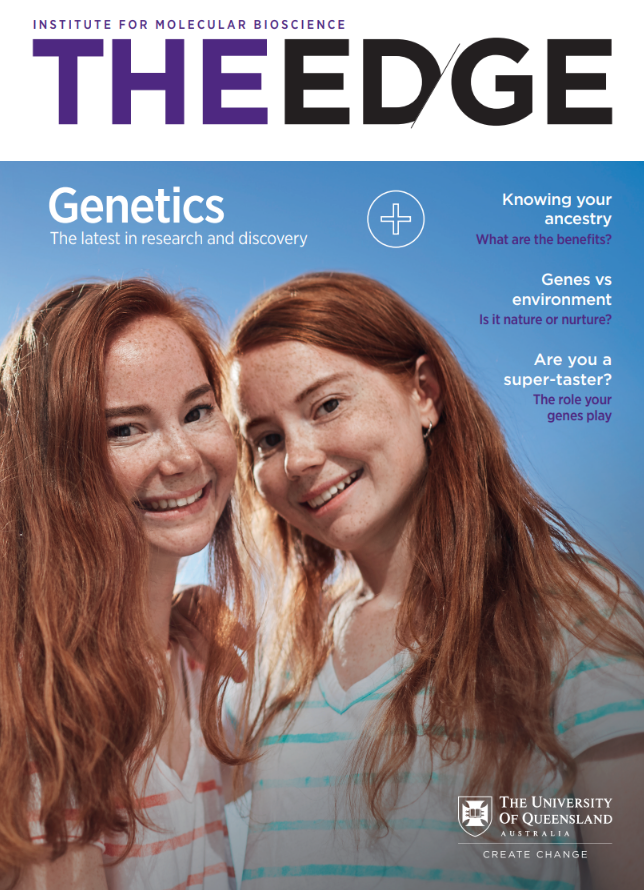
The Edge: Genetics
People have known for thousands of years that parents pass traits to their children, but it is only relatively recently that our technology has caught up to our curiosity, enabling us to delve into the mystery of how this inheritance occurs, and the implications for predicting, preventing and treating disease.
Subscribe to our newsletter
Get the latest research straight to your inbox.
Stay up-to-date as we answer questions about hot topics, and share the latest news at IMB, Australia’s #1 research institute.
General enquiries
+61 7 3346 2222
imb@imb.uq.edu.au
Media enquiries
IMB fully supports UQ's Reconciliation Action Plan and is implementing actions within our institute.
Support us
Donate to research
100% of donations go to the cause