
Get the latest research to your inbox
- Masters studentThe Institute for Molecular Bioscience
- PhD studentInstitute for Molecular Bioscience
- Director, Institute OperationsInstitute for Molecular Bioscience
- Research AssistantInstitute for Molecular Bioscience
Evans Group
Group Leader
Professor David Evans
Professorial Research Fellow and Director, Centre for Population and Disease GenomicsInstitute for Molecular BioscienceResearcher profile is public:1Supervisor:Researcher biography:David Evans is an NHMRC Leadership Fellow and Professor of Statistical Genetics at the University of Queensland Institute for Molecular Bioscience. He is a winner of the NHMRC Marshall and Warren Award.
He completed his PhD in Statistical Genetics at the University of Queensland in 2003, before undertaking a four-year post-doctoral fellowship at the Wellcome Trust Centre for Human Genetics, University of Oxford where he worked as part of the The International HapMap Consortium and co-led the analysis of four diseases within the first Wellcome Trust Case Control Consortium. In 2007 he moved to take up a Senior Lecturer position at the University of Bristol where he led much of the genome-wide association studies work in the Avon Longitudinal Study of Parents and Children (ALSPAC). In 2013 he returned to take up a chair at the University of Queensland whilst continuing to lead an MRC Programme in statistical genetics at the University of Bristol.
His research interests include the genetic mapping of complex traits and diseases (including birthweight and other perinatal traits, osteoporosis, ankylosing spondylitis, sepsis, laterality) and the development of statistical methodologies in genetic epidemiology including approaches for gene mapping, individual risk prediction, causal modelling and dissecting the genetic architecture of complex traits. He has a particular interest in Mendelian randomization and has used it and other causal methods to investigate the Developmental Origins of Health and Disease (DOHaD)- the idea that adverse intrauterine exposures lead to increased risk of disease in later life.
He is Academic Codirector at the NIH funded International Workshop on Statistical Genetics Methods and is faculty on the European Programme in Educational Epidemiology.
He is Associate Editor at the International Journal of Epidemiology and Behavior Genetics journals.
Researchers
Dr Daniel Hwang
ARC DECRAInstitute for Molecular BioscienceResearcher profile is public:1Supervisor:Researcher biography:Dr Daniel Liang-Dar Hwang is a genetic epidemiologist and statistical geneticist by training. His research interests include sensory nutrition, causal modelling, and personalized nutrition. Dr Hwang applies statistical models to big data to understand genetic and environmental factors contributing to individual differences in taste and olfactory perception and their relationship with dietary behaviour and chronic conditions (See his research on taste perception in The Conversation). He develops methods for increasing statistical power for gene discovery, estimating intergenerational causal relationships, and personalized intervention. He also works with clinicians to investigate impaired chemosensory perception in cancer patients and COVID-19.
Daniel has a B.Sc from the National Taiwan University, majoring in Biochemical Science and Technology, and an M.Biotech from the University of Pennsylvania. Following graduation, he worked as a research technician in Danielle Reed's lab at the Monell Chemical Senses Center, where he first developed a keen interest in genetics and chemosensory perception. Later, he was awarded scholarships to complete an M.Sc in Nutrition at the University of Washington, under the supervision of Glen Duncan, and a PhD in Genetic Epidemiology at the QIMR Berghofer Medical Research Institute, under the supervision of Nicholas Martin and Margaret Wright. He then joined David Evans's group as a postdoc at the University of Queensland Diamantina Institute (now the Frazer Institute). Dr Hwang is an ARC DECRA Fellow at the Institute for Molecular Bioscience. He is also an Affiliated Scientist at the Monell Chemical Senses Center.
Dr Hwang has published more than 50 peer-reviewed publications. His work has been referred to in international health policy guidelines and a WHO report for the intervention of childhood obesity and in a global patent for personalized wine selection. He is on the editorial boards of BMC Medicine and Twin Research and Human Genetics. Dr Hwang is a Leadership Team member of the Global Consortium for Chemosensory Research, a global initiative to understand the relationship between smell loss and COVID-19 and foster the advancement of chemosensory science. He currently drives an international collaborative project to investigate the impact of COVID-19 vaccinations on long-COVID symptoms. Dr Hwang is a member of the National Committee for Nutrition of the Australian Academy of Science. He contributes to implementing the decadal plan for the science of nutrition in Australia.
Dr Nicole Warrington
Senior Research FellowInstitute for Molecular BioscienceResearcher profile is public:1Supervisor:Researcher biography:Dr Nicole Warrington is a NHMRC Emerging Leadership Fellow at the University of Queensland Institute for Molecular Bioscience. She has a strong background in statistical genetics and has been actively working towards understanding the genetic determinants of early life growth. Dr Warrington studied a Bachelor of Science at Victoria University in Wellington, New Zealand, majoring in Mathematical Statistics and Psychology. She then completed an honours degree at The University of Western Australia, where she developed a keen interest for genetics, and was subsequently awarded an Australian Postgraduate Award to complete her PhD in statistical genetics and life-course epidemiology. During her PhD she spent time at the University of Toronto to gain experience in statistical modelling methods for longitudinal growth trajectories and conducted the first genome-wide association study of longitudinal growth trajectories over childhood. After completing her PhD, Dr Warrington started at the University of Queensland and focused on using genetics to inform about the relationship between birth weight and cardio-metabolic diseases in later life. She pioneered a new statistical method to partition genetic effects on birth weight into maternal and fetal components, and combined this method with a causal modelling approach, Mendelian randomization. This method was instrumental in demonstrating the relationship between birth weight and adult hypertension is driven by genetic effects, over-turning 30 years of research into the effects of intrauterine programming. More recently, her research focus has broadened to determine whether rapid weight growth across early life, including fetal development, childhood and adolescence, causally increases risk of cardio-metabolic disease and in doing so, hopes to identify optimal times across the life-course where interventions could reduce the incidence of cardio-metabolic diseases.
Ms Caroline Brito Nunes
Casual Research AssistantInstitute for Molecular BioscienceResearcher profile is public:0Supervisor:Dr Alesha Hatton
Postdoctoral Research FellowInstitute for Molecular BioscienceResearcher profile is public:1Supervisor:Researcher biography:Alesha Hatton is a postdoctoral research fellow specializing in statistical genetics and genetic epidemiology at the Institute for Molecular Bioscience, University of Queensland. Currently, her research focuses on understanding the genetic and environmental aetiology underlying complex traits through use of Mendelian randomization and statistical genetics methodologies. Her PhD was in systems genomics, applying quantitative genetics methods to investigate the role of DNA methylation in complex trait variation. Alesha has a bachelor's degree in medical mathematics from the University of Wollongong and previously was employed as a statistician at the South Australian health and Medical Research Institute.
Visiting Researchers
Dr Tom Bond
Visiting ResearcherInstitute for Molecular BioscienceResearcher profile is public:1Supervisor:Dr Gabriel Cuellar-Partida
Visiting ResearcherInstitute for Molecular BioscienceResearcher profile is public:1Supervisor:Students
Mr Giulio Centorame
PhD student & Casual Research AssistantInstitute for Molecular BioscienceResearcher profile is public:0Supervisor:Ms Caitlin Decina
PhD studentInstitute for Molecular BioscienceResearcher profile is public:1Supervisor:Ms Shannon D’Urso
PhD studentInstitute for Molecular BioscienceResearcher profile is public:1Supervisor:Ms Emily Daubney
PhD studentInstitute for Molecular BioscienceResearcher profile is public:1Supervisor:Ms Kaitlyn Flynn
PhD studentInstitute for Molecular BioscienceResearcher profile is public:1Supervisor:Mr Mischa Lundberg
PhD studentInstitute for Molecular BioscienceResearcher profile is public:1Supervisor:Miss Alice Schulz
PhD studentInstitute for Molecular BioscienceResearcher profile is public:1Supervisor:Dr Geng Wang
Postdoctoral Research FellowInstitute for Molecular BioscienceResearcher profile is public:1Supervisor:Researcher biography:Dr. Geng Wang is a postdoctoral research fellow specializing in statistical genetics and genetic epidemiology at the Institute for Molecular Bioscience, University of Queensland. His research focuses on the developmental origins of health and diseases, causal inference in genetic epidemiology, genetic susceptibility of complex traits and diseases, and the advancement of statistical genetics methodologies. Proficient in bioinformatics, statistical genetics, and clinical research, he has a background in clinical medicine and the biotechnology industry.
Dr. Wang obtained his bachelor's degree in clinical medicine and master's degree in internal medicine from Second Military Medical University (Shanghai, China) in 2012 and 2016, respectively. He served as a resident physician at Changzheng Hospital, affiliated with Second Military Medical University, from 2016 to 2017, specialising in rheumatology, before being promoted to an attending doctor. During his time in Shanghai, he was invited to visit the Translational Research Institute (Australia) twice in 2016 and 2017 for bioinformatics training and collaborative research.
Driven by his growing interest in human genetics, Dr. Wang pursued a Ph.D. in statistical genetics with Professor David Evans at the University of Queensland, which he successfully completed in 2023. Since then, he has continued his research in the aforementioned areas, contributing to the field with his diverse background and expertise.
- Institute for Molecular Bioscience
- Higher degree by research (PhD) studentInstitute for Molecular Bioscience
Parton Group
Group Leader
Professor Robert Parton
Group Leader, Centre for Cell Biology of Chronic DiseaseARC Laureate Fellow - Group LeaderInstitute for Molecular BioscienceResearcher profile is public:1Supervisor:Researcher biography:Our research focuses on understanding how cells work and what goes wrong in disease. We are studying the role of cellular organelles in defence against pathogens, the molecular changes underlying muscle disease, and optimising methods to deliver therapeutics to specific cell types in whole animals.
Professor Robert Parton is an ARC Laureate Fellow, a group leader in the IMB Centre for Cell Biology of Chronic Disease, and Deputy Director of the Centre for Microscopy and Microanalysis. He is a Fellow of the Australian Academy of Science and an Associate Member of EMBO.
Body:Highlights
Professor Rob Parton studies cells - the building blocks of life. His unique methodology uses electron microscopy to create 3D models of cells, which he then explores interactively with virtual reality.
As a cell biologist, Professor Parton has always been fascinated by the cell and captivated by the beauty that visualising a cell through microscopy reveals. He is the only researcher using this technique. Following his degree in Scotland and PhD in England, he went on to participate in fundamental science at The European Molecular Biology Laboratory in Heidelberg, Germany. It was a pivotal chapter in his career.
He is best known for understanding how the plasma membrane of cells works, and particularly the crater-like indents in the cell membrane called Caveolae. By revealing how the cell structure works, and most importantly what goes wrong in disease, Professor Parton is identifying the drug targets of the future. The range of techniques that he uses, working at the cellular level right through to using animals in cell biology, sets his research apart.
Professor Parton is Chief Editor of Traffic and Associate Editor for Molecular Biology of the Cell. He is a Fellow of the Australian Academy of Science.
Videos
Connect


Researchers
Mr Charles Ferguson
Researcher profile is public:0Supervisor:Dr Tom Hall
Senior Research FellowInstitute for Molecular BioscienceResearcher profile is public:1Supervisor:Dr Ye-Wheen Lim
Higher degree by research (PhD) student & Postdoctoral Research FellowInstitute for Molecular BioscienceResearcher profile is public:1Supervisor:Dr Harriet Lo
Research FellowInstitute for Molecular BioscienceResearcher profile is public:1Supervisor:Mr Nick Martel
Research AssistantInstitute for Molecular BioscienceResearcher profile is public:0Supervisor:Dr Susan Nixon
Laboratory ManagerInstitute for Molecular BioscienceResearcher profile is public:0Supervisor:Mr James Rae
Researcher profile is public:0Supervisor:Dr Yeping Wu
Postdoctoral Research FellowInstitute for Molecular BioscienceResearcher profile is public:1Supervisor:Dr Thai Duong Luong
Postdoctoral Research FellowInstitute for Molecular BioscienceResearcher profile is public:1Supervisor:Dr Igor Bonacossa Pereira
Postdoctoral ScientistInstitute for Molecular BioscienceResearcher profile is public:1Supervisor:Researcher biography:Cells are the unit of life.
From the highly elongated neurons to the resilient and all enwrapping epithelial cells my work unravels a cell's structural building blocks, their repair tools and anti-infective arsenal.
My research aims at understanding the fundamental mechanisms by which cells maintain their integrity, fight infection and regulate their interface with the outside world, the membrane.
To study these elements I use a tiny roundworm called C. elegans as a model system and use precision gene editing, molecular biology, state-of-the-art microscopy and classical genetics.
Dr Dominic Hunter
Senior Research AssistantInstitute for Molecular BioscienceResearcher profile is public:0Supervisor:Students
Ms Le Nguyen
PhD StudentInstitute for Molecular BioscienceResearcher profile is public:1Supervisor:Mr Lucas Thor
PhD StudentInstitute for Molecular BioscienceResearcher profile is public:1Supervisor:Ms Navia John
PhD StudentInstitute for Molecular BioscienceResearcher profile is public:0Supervisor:Miss Haolan Sun
PhD StudentInstitute for Molecular BioscienceResearcher profile is public:0Supervisor:
Pages
Strawberry DNA extraction activity
Extract and view DNA from a strawberry using common household ingredients.
Get started
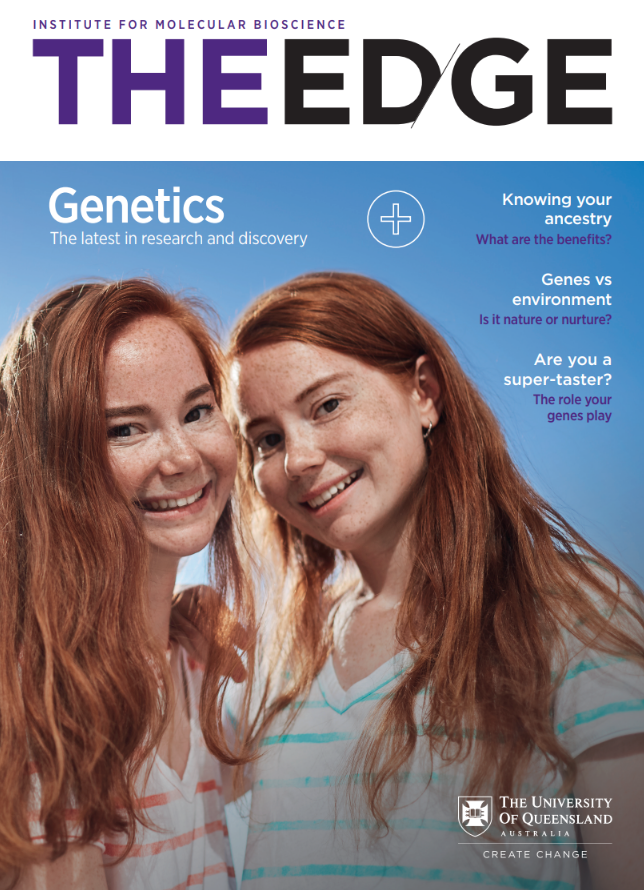
The Edge: Genetics
People have known for thousands of years that parents pass traits to their children, but it is only relatively recently that our technology has caught up to our curiosity, enabling us to delve into the mystery of how this inheritance occurs, and the implications for predicting, preventing and treating disease.
Subscribe to our newsletter
Get the latest research straight to your inbox.
Stay up-to-date as we answer questions about hot topics, and share the latest news at IMB, Australia’s #1 research institute.
General enquiries
+61 7 3346 2222
imb@imb.uq.edu.au
Media enquiries
IMB fully supports UQ's Reconciliation Action Plan and is implementing actions within our institute.
Support us
Donate to research
100% of donations go to the cause


