

Get the latest research to your inbox
- StudentInstitute for Molecular Bioscience
- Research OfficerInstitute for Molecular Bioscience
Schembri group
Group Leader
Professor Mark Schembri
Centre Director of Institute for Molecular Bioscience & Professorial Research Fellow & Group LeaderInstitute for Molecular BioscienceResearcher profile is public:1Supervisor:Researcher biography:Professor Mark Schembri is a prominent microbiologist with experience in combating the global health crisis presented by multi-drug resistant pathogens. Professor Schembri's expertise on the virulence of bacterial pathogens and his innovative analysis of biofilm formation aims to improve the outcomes of the >400 million individuals that suffer from urinary tract infections each year across the globe.
Through the application of genetic, genomic and functional studies on uropathogenic E. coli, Professor Schembri has identified targets to reduce the virulence of this pathogen, and will pursue the development of life-saving therapeutic and preventative advances with the assistance of NHMRC, MRFF and ARC grants. Professor Schembri has tracked the rapid emergence and global spread of a virulent, drug-resistant E. coli clone and used genome sequencing to understand its evolution and virulence.
Links: Professor Schembri collaborates with national and international research leaders, including in Denmark, where he was a lecturer. Professor Schembri has strong links with other international experts in his field, including at the Pasteur Institute and the Wellcome Trust Sanger Institute in Cambridge. His research collaborations also span lead groups at UQ and other top Australian institutes, including Griffith and La Trobe Universities.
Membership, Funding and patents: Since 2014, Professor Schembri has been awarded over $15 million in funding from competitive national research funding bodies. He holds provisional patents for the development of novel therapeutic agents and vaccine antigens. He is a Fellow of the American Academy of Microbiology, and is regularly invited to speak at international conferences in his field.
Awards and Communication: Professor Schembri was the recipient of the Frank Fenner Award (2010) and the ASM BacPath Oration Award (2019) for his outstanding original research contribution to the study of Infectious Disease. He was an Australian Research Council Future Fellow (2011-2015) a National Health and Medical Research Council Senior Research Fellow (2016-2020). Professor Schembri is the author of >240 peer-reviewed research manuscripts. He is President of the Australian Society for Microbiology (2022-2026).
Researchers
Dr Duy Phan
Research FellowInstitute for Molecular BioscienceResearcher profile is public:1Supervisor:Researcher biography:I got my BSc degree from the University of Natural Sciences in Vietnam. I spent the next two years working on characterisation of multi-drug resistant Mycobacterium tuberculosis with Dr Maxine Caws at the Oxford University Clinical Research Unit in Ho Chi Minh City, Vietnam. I went to the Wellcome Trust Sanger Institute and the University of Cambridge, UK to do my PhD in Prof. John Wain lab where I studied molecular mechanisms affecting the stability of IncHI1 multidrug resistant plasmids in Salmonella Typhi. I then moved to Australia to join the group of Prof. Mark Schembri at the School of Chemistry and Molecular Biosciences, University of Queensland. I am now working on identifying novel virulent factors in uropathogenic E. coli, especially in the newly emerged but globally spread ST131 clone, using high-throughput transposon mutagenesis and next-gen sequencing. I also maintain my interest in plasmid biology and have started projects to study multidrug resistant plasmids carrying blaCTX-M-15 or blaNDM-1 resistant genes.
Dr Zack Lian
Postdoctoral Research FellowInstitute for Molecular BioscienceResearcher profile is public:1Supervisor:Dr Nhu Nguyen
Research FellowInstitute for Molecular BioscienceResearcher profile is public:1Supervisor:Dr Yvette Ong
Postdoctoral Research FellowInstitute for Molecular BioscienceResearcher profile is public:1Supervisor:Lab Manager
Dr Kate Peters
Senior Research ManagerInstitute for Molecular BioscienceResearcher profile is public:0Supervisor:Senior Research Assistant
Ms Chelsea Stewart
Senior Research AssistantInstitute for Molecular BioscienceResearcher profile is public:0Supervisor:Students
Miss Irene Martinez Roman
PhD StudentInstitute for Molecular BioscienceResearcher profile is public:0Supervisor:Mr Lachlan Walker
PhD studentInstitute for Molecular BioscienceResearcher profile is public:1Supervisor:Mr Samuel Morris
Honours StudentInstitute for Molecular BioscienceResearcher profile is public:1Supervisor:Miss Susan Chamorro-Rodriguez
Researcher profile is public:0Supervisor:- Research AssistantInstitute for Molecular Bioscience
- Postdoctoral Research FellowInstitute for Molecular Bioscience
Parton Group
Group Leader
Professor Robert Parton
Group Leader, Centre for Cell Biology of Chronic DiseaseARC Laureate Fellow - Group LeaderInstitute for Molecular BioscienceResearcher profile is public:1Supervisor:Researcher biography:Our research focuses on understanding how cells work and what goes wrong in disease. We are studying the role of cellular organelles in defence against pathogens, the molecular changes underlying muscle disease, and optimising methods to deliver therapeutics to specific cell types in whole animals.
Professor Robert Parton is an ARC Laureate Fellow, a group leader in the IMB Centre for Cell Biology of Chronic Disease, and Deputy Director of the Centre for Microscopy and Microanalysis. He is a Fellow of the Australian Academy of Science and an Associate Member of EMBO.
Body:Highlights
Professor Rob Parton studies cells - the building blocks of life. His unique methodology uses electron microscopy to create 3D models of cells, which he then explores interactively with virtual reality.
As a cell biologist, Professor Parton has always been fascinated by the cell and captivated by the beauty that visualising a cell through microscopy reveals. He is the only researcher using this technique. Following his degree in Scotland and PhD in England, he went on to participate in fundamental science at The European Molecular Biology Laboratory in Heidelberg, Germany. It was a pivotal chapter in his career.
He is best known for understanding how the plasma membrane of cells works, and particularly the crater-like indents in the cell membrane called Caveolae. By revealing how the cell structure works, and most importantly what goes wrong in disease, Professor Parton is identifying the drug targets of the future. The range of techniques that he uses, working at the cellular level right through to using animals in cell biology, sets his research apart.
Professor Parton is Chief Editor of Traffic and Associate Editor for Molecular Biology of the Cell. He is a Fellow of the Australian Academy of Science.
Videos
Connect


Researchers
Mr Charles Ferguson
Researcher profile is public:0Supervisor:Dr Tom Hall
Senior Research FellowInstitute for Molecular BioscienceResearcher profile is public:1Supervisor:Dr Ye-Wheen Lim
Higher degree by research (PhD) student & Postdoctoral Research FellowInstitute for Molecular BioscienceResearcher profile is public:1Supervisor:Dr Harriet Lo
Research FellowInstitute for Molecular BioscienceResearcher profile is public:1Supervisor:Mr Nick Martel
Research AssistantInstitute for Molecular BioscienceResearcher profile is public:0Supervisor:Dr Susan Nixon
Laboratory ManagerInstitute for Molecular BioscienceResearcher profile is public:0Supervisor:Mr James Rae
Researcher profile is public:0Supervisor:Dr Yeping Wu
Postdoctoral Research FellowInstitute for Molecular BioscienceResearcher profile is public:1Supervisor:Dr Thai Duong Luong
Postdoctoral Research FellowInstitute for Molecular BioscienceResearcher profile is public:1Supervisor:Dr Igor Bonacossa Pereira
Postdoctoral ScientistInstitute for Molecular BioscienceResearcher profile is public:1Supervisor:Researcher biography:Cells are the unit of life.
From the highly elongated neurons to the resilient and all enwrapping epithelial cells my work unravels a cell's structural building blocks, their repair tools and anti-infective arsenal.
My research aims at understanding the fundamental mechanisms by which cells maintain their integrity, fight infection and regulate their interface with the outside world, the membrane.
To study these elements I use a tiny roundworm called C. elegans as a model system and use precision gene editing, molecular biology, state-of-the-art microscopy and classical genetics.
Dr Dominic Hunter
Senior Research AssistantInstitute for Molecular BioscienceResearcher profile is public:0Supervisor:Students
Ms Le Nguyen
PhD StudentInstitute for Molecular BioscienceResearcher profile is public:1Supervisor:Mr Lucas Thor
PhD StudentInstitute for Molecular BioscienceResearcher profile is public:1Supervisor:Ms Navia John
PhD StudentInstitute for Molecular BioscienceResearcher profile is public:0Supervisor:Miss Haolan Sun
PhD StudentInstitute for Molecular BioscienceResearcher profile is public:0Supervisor:- Identifying new methods to diagnose, prevent and treat infections before they become life-threatening
Pages
Strawberry DNA extraction activity
Extract and view DNA from a strawberry using common household ingredients.
Get started
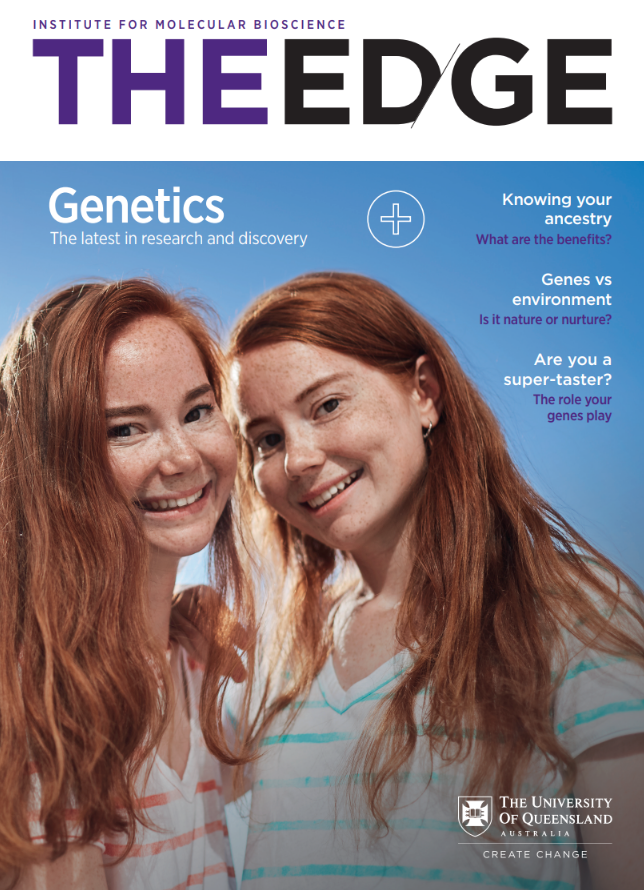
The Edge: Genetics
People have known for thousands of years that parents pass traits to their children, but it is only relatively recently that our technology has caught up to our curiosity, enabling us to delve into the mystery of how this inheritance occurs, and the implications for predicting, preventing and treating disease.
Subscribe to our newsletter
Get the latest research straight to your inbox.
Stay up-to-date as we answer questions about hot topics, and share the latest news at IMB, Australia’s #1 research institute.
General enquiries
+61 7 3346 2222
imb@imb.uq.edu.au
Media enquiries
IMB fully supports UQ's Reconciliation Action Plan and is implementing actions within our institute.
Support us
Donate to research
100% of donations go to the cause