

Get the latest research to your inbox
- Casual Senior Research TechnicianInstitute for Molecular Bioscience
- Research AssistantInstitute for Molecular Bioscience
Palpant Group
Group Leader
Professor Nathan Palpant
National Heart Foundation of Australia Future Leader Fellow - Group LeaderInstitute for Molecular BioscienceResearcher profile is public:1Supervisor:Researcher biography:Career Summary: 2009: PhD, University of Michigan, USA with training in cardiac physiology, modelling myocardial ischemia in vivo and in vitro, and development of therapeutic approaches for myocardial ischemia; 2009–2015: Postdoctoral Research Fellow, University of Washington, Institute for Stem Cell and Regenerative Medicine, USA with training in stem cell biology, genomics, genome editing, and cell therapeutics for ischemic heart disease; 2015–current: Group Leader, University of Queensland (UQ), Institute for Molecular Bioscience; 2022-current: Associate Professor, UQ; 2018–2021 and 2023-2026: National Heart Foundation Future Leader Fellow. Dr. Palpant's research team has expertise in human stem cell biology, computational genomics, and cardiac physiology, which enables them to translate outcomes from cell biology and genomics to disease modelling, drug discovery, and preclinical modelling.
Body:Latest publication
Dr Palpant and colleagues have published the most in-depth study of exactly how human stem cells can be turned into heart cells. The work involved measuring changes in gene activity in tens of thousands of individual cells as they move through the stages of heart development.
Unlike those tissues, the heart does not have the capacity for self-repair after damage (such as a heart attack). This is one reason why heart disease is the leading cause of death worldwide. This research may help us find ways to repair the heart in the future. Read more
Highlights
The Stem Cells and Cardiovascular Development lab run by Dr Nathan Palpant uses human pluripotent stem cells (hPSCs), genomics, genome editing, and disease modelling to study mechanisms controlling cardiovascular development and disease.
Cardiovascular disease is the leading cause of death worldwide and new therapeutics are required to address growing public health demands. Expanding treatment options for cardiovascular diseases requires interdisciplinary research from developmental biology to translation.
To this end, Dr Palpant leads functional genomics and epigenetic studies at single cell resolution and across diverse cardiac and vascular fates to determine the genetic basis of cell identity and fate.
His team is developing stem cell models of disease for drug discovery. They are also building links with clinician/researchers bringing together stem cell biology, mechanical-assist devices, and large animal disease models to identify new approaches to address cardiovascular disease.
Dr Palpant received training in cardiac physiology (PhD, University of Michigan) and developmental biology and genomics (University of Washington), resulting in 27 publications in high-impact journals including Nature, Nature Protocols, and Development.
In November 2015, Dr Palpant relocated to The University of Queensland’s Institute for Molecular Bioscience to establish the Stem Cells and Cardiovascular Development Laboratory.
During his career, Dr Palpant has received internationally competitive awards and positions including:
- The International Society for Heart Research Young Investigator Award
- International speaking invitations in the US, Europe, Australia, and Asia
- He is an IMB Group Leader, Co-Director of Stem Cells Australia’s Cardiac Repair and Regeneration theme, and Co-Director of the Queensland Facility for Advanced Genome Editing.
Video
Using genomics to elucidate developmental cell lineage decisions, Dr Nathan Palpant
Connect


Researchers
Dr Woo Jun Shim
Postdoctoral Research FellowInstitute for Molecular BioscienceResearcher profile is public:1Supervisor:Researcher biography:Dr Shim's research revolves around developing computational methods to understand determinants of cell identity by analysing various genomic data. Trained in bioinformatics, pharmacy and biomedical science (majoring in biochemistry and immunology), Dr Shim incorporates inter-disciplinary knowledge to solve research questions in both basic science and translational medicine.
Dr Yuanzhao Cao
Postdoctoral Research FellowInstitute for Molecular BioscienceResearcher profile is public:1Supervisor:Researcher biography:As a cell biologist specialising in molecular and cell biology and stem cell biology, my work focuses on cardiovascular development, stem cell-base disease modelling and pharmaceutical drug discovery. Specifically, I concentrate on ischaemic heart injury and diabetic cardiomyopathy, aiming to develop novel therapeutics to reduce hospitalisations and community health burdens. I have 13 career publications and an h-index of 5 (Web of Science); 83.3% of my publications are in Q1 journals (SciVal). Across my research career, the topic areas in publications include studies in cell biology (4), development biology (3), pharmacology (3), and cardiovascular system-cardiology (2) (Web of Science). In the last five years, 60% of my publications are in the top 10% of journals, and the studies cover biochemistry, genetics and molecular biology (3 outputs), and medicine (2 outputs) (SciVal). I have held leadership roles including member of International Society for Heart Research Australasia Early Career Investigator Committee, member of the Queensland Cardiovascular Research Network (QCVRN) Emerging Leaders Committee, member of the Early-Mid Career Researchers (EMCR) Association for IMB, UQ. I am organising EMCR Session for the 2024 Cardiac Society of Australia and New Zealand annual scientific meeting, the 2024 QCVRN & Heart Foundation Research Showcase, the 2024 IMB EMCR Retreat meeting, and was organisation committee member for the 2023 Australia Network of Cardiac and Vascular Developmental Biology conference. I review for journals including Stem Cell Reports, Stem Cells, IUBMB Life and co-review for journals including Nature Methods, Cell Stem Cell, Journal of Molecular and Cellular Cardiology. I am a special guest editor for the journal Pathogens on the Special Issue: Innate Immunity against Pathogens.
Miss Jun Chen
Research AssistantInstitute for Molecular BioscienceResearcher profile is public:1Supervisor:Dr Qiong-Yi Zhao
Postdoctoral Research FellowInstitute for Molecular BioscienceResearcher profile is public:1Supervisor:Dr Amy Hanna
Postdoctoral Research FellowInstitute for Molecular BioscienceResearcher profile is public:1Supervisor:Miss Clarissa Tan
Senior Research AssistantInstitute for Molecular BioscienceResearcher profile is public:0Supervisor:Dr Xiaoli Chen
Senior Principal ResearcherInstitute for Molecular BioscienceResearcher profile is public:0Supervisor:Dr Sophie Shen
Researcher profile is public:0Supervisor:Dr Dannie Fobian
Research FellowInstitute for Molecular BioscienceResearcher profile is public:1Supervisor:Students
Miss Dalia Mizikovsky
PhD studentInstitute for Molecular BioscienceResearcher profile is public:0Supervisor:Ms Sumedha Negi
PhD studentInstitute for Molecular BioscienceResearcher profile is public:1Supervisor:Mr Chris Siu Yeung Chow
Research Assistant/PhD StudentInstitute for Molecular BioscienceResearcher profile is public:1Supervisor:Miss Shaine Bao
Research Assistant/PhD StudentInstitute for Molecular BioscienceResearcher profile is public:1Supervisor:Ms Anna Raio Afonso Zatz
Honours StudentInstitute for Molecular BioscienceResearcher profile is public:1Supervisor:- Dr Anna Vinkhuyzen converts scientific discoveries into healthcare initiatives, and thinks we should focus on men as well as women if we want to get more women in science.
- Human Resources Business PartnerInstitute for Molecular Bioscience
- Higher degree by research (PhD) studentInstitute for Molecular Bioscience
Pages
Strawberry DNA extraction activity
Extract and view DNA from a strawberry using common household ingredients.
Get started
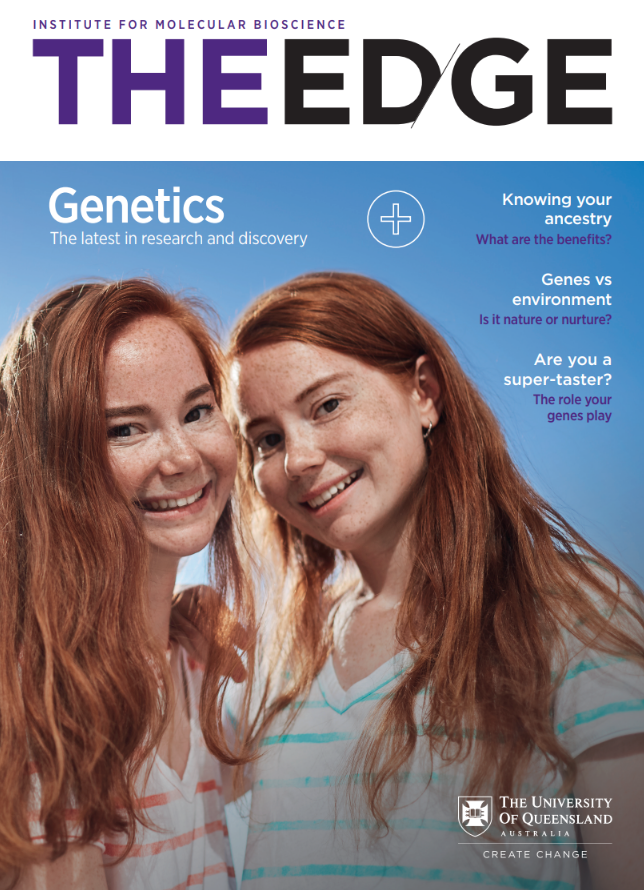
The Edge: Genetics
People have known for thousands of years that parents pass traits to their children, but it is only relatively recently that our technology has caught up to our curiosity, enabling us to delve into the mystery of how this inheritance occurs, and the implications for predicting, preventing and treating disease.
Subscribe to our newsletter
Get the latest research straight to your inbox.
Stay up-to-date as we answer questions about hot topics, and share the latest news at IMB, Australia’s #1 research institute.
General enquiries
+61 7 3346 2222
imb@imb.uq.edu.au
Media enquiries
IMB fully supports UQ's Reconciliation Action Plan and is implementing actions within our institute.
Support us
Donate to research
100% of donations go to the cause