

Get the latest research to your inbox
- Researchers from The University of Queensland have helped identify nearly 1,500 genes associated with ageing that could lead to new health treatments.
Dr Joseph Powell, from UQ’s Institute for Molecular Bioscience (IMB), said the discovery, made by an international team of scientists, could lead to improved prevention and treatment for age-related diseases - Please join us on 17 November 2015 for the screening of the film “RESISTANCE” which looks at the devastating impact of antibiotic resistance and asks “Do we need to save antibiotics to save ourselves?”
- 19 October 201519 October 2015
- Researchers from the Institute for Molecular Bioscience (IMB) have made advances in understanding the cellular processes that occur during wound healing, skin cancer, and inflammatory skin conditions such as psoriasis.
- Australian researchers have perfected a method of growing mini-kidneys from stem cells for use in drug screening, disease modelling and cell therapy.
- After almost a decade of intense study in the fields of chemistry and biology, IMB PhD student Wanida Phetsang has been awarded a scholarship with technical solutions company 3M, where she has been using her knowledge to help in the development of healthcare products at the company’s research and development centre in Bangkok.
- University of Queensland scientists have provided insight into the cause of muscle diseases including limb-girdle muscular dystrophy and rippling muscle disease.
- The University of Queensland has held its position among the world’s top 50 universities, ranking 46th globally and number one in Queensland in the 2015/16 QS World University Rankings.
- A drug development project that combines the expertise of Pfizer and Institute for Molecular Bioscience researchers has been recognised at a University of Queensland awards ceremony.
Pages
Strawberry DNA extraction activity
Extract and view DNA from a strawberry using common household ingredients.
Get started
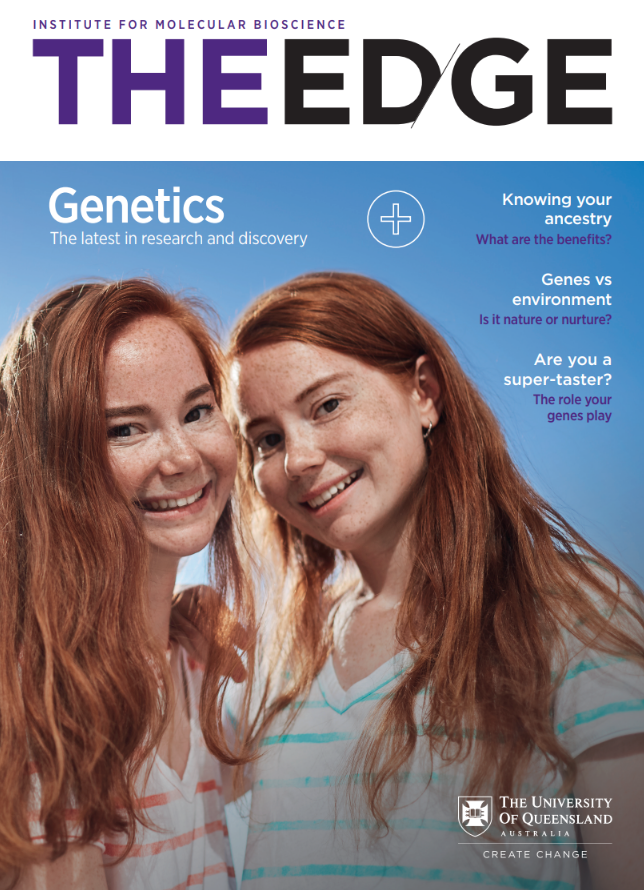
The Edge: Genetics
People have known for thousands of years that parents pass traits to their children, but it is only relatively recently that our technology has caught up to our curiosity, enabling us to delve into the mystery of how this inheritance occurs, and the implications for predicting, preventing and treating disease.
Subscribe to our newsletter
Get the latest research straight to your inbox.
Stay up-to-date as we answer questions about hot topics, and share the latest news at IMB, Australia’s #1 research institute.
General enquiries
+61 7 3346 2222
imb@imb.uq.edu.au
Media enquiries
IMB fully supports UQ's Reconciliation Action Plan and is implementing actions within our institute.
Support us
Donate to research
100% of donations go to the cause