
IMB's latest news, explainers and more


Supporting life-saving research at CCRG

Read more

Get the latest research to your inbox

Subscribe
 

  • PhD student
    Institute for Molecular Bioscience
  • HR Business Partner
    Institute for Molecular Bioscience
  • Visiting Scholar
    Institute for Molecular Bioscience
  • Evans Group

    Group Leader

    Professor David Evans

    Professorial Research Fellow and Director, Centre for Population and Disease Genomics
    Institute for Molecular Bioscience
    Researcher profile is public: 
    1
    Supervisor: 
    Researcher biography: 

    David Evans is an NHMRC Leadership Fellow and Professor of Statistical Genetics at the University of Queensland Institute for Molecular Bioscience. He is a winner of the NHMRC Marshall and Warren Award.

    He completed his PhD in Statistical Genetics at the University of Queensland in 2003, before undertaking a four-year post-doctoral fellowship at the Wellcome Trust Centre for Human Genetics, University of Oxford where he worked as part of the The International HapMap Consortium and co-led the analysis of four diseases within the first Wellcome Trust Case Control Consortium. In 2007 he moved to take up a Senior Lecturer position at the University of Bristol where he led much of the genome-wide association studies work in the Avon Longitudinal Study of Parents and Children (ALSPAC). In 2013 he returned to take up a chair at the University of Queensland whilst continuing to lead an MRC Programme in statistical genetics at the University of Bristol.

    His research interests include the genetic mapping of complex traits and diseases (including birthweight and other perinatal traits, osteoporosis, ankylosing spondylitis, sepsis, laterality) and the development of statistical methodologies in genetic epidemiology including approaches for gene mapping, individual risk prediction, causal modelling and dissecting the genetic architecture of complex traits. He has a particular interest in Mendelian randomization and has used it and other causal methods to investigate the Developmental Origins of Health and Disease (DOHaD)- the idea that adverse intrauterine exposures lead to increased risk of disease in later life.

    He is Academic Codirector at the NIH funded International Workshop on Statistical Genetics Methods and is faculty on the European Programme in Educational Epidemiology.

    He is Associate Editor at the International Journal of Epidemiology and Behavior Genetics journals.

    Researchers

    Dr Daniel Hwang

    ARC DECRA
    Institute for Molecular Bioscience
    Researcher profile is public: 
    1
    Supervisor: 
    Researcher biography: 

    Dr Daniel Liang-Dar Hwang is a genetic epidemiologist and statistical geneticist by training. His research interests include sensory nutrition, causal modelling, and personalized nutrition. Dr Hwang applies statistical models to big data to understand genetic and environmental factors contributing to individual differences in taste and olfactory perception and their relationship with dietary behaviour and chronic conditions (See his research on taste perception in The Conversation). He develops methods for increasing statistical power for gene discovery, estimating intergenerational causal relationships, and personalized intervention. He also works with clinicians to investigate impaired chemosensory perception in cancer patients and COVID-19.

    Daniel has a B.Sc from the National Taiwan University, majoring in Biochemical Science and Technology, and an M.Biotech from the University of Pennsylvania. Following graduation, he worked as a research technician in Danielle Reed's lab at the Monell Chemical Senses Center, where he first developed a keen interest in genetics and chemosensory perception. Later, he was awarded scholarships to complete an M.Sc in Nutrition at the University of Washington, under the supervision of Glen Duncan, and a PhD in Genetic Epidemiology at the QIMR Berghofer Medical Research Institute, under the supervision of Nicholas Martin and Margaret Wright. He then joined David Evans's group as a postdoc at the University of Queensland Diamantina Institute (now the Frazer Institute). Dr Hwang is an ARC DECRA Fellow at the Institute for Molecular Bioscience. He is also an Affiliated Scientist at the Monell Chemical Senses Center.

    Dr Hwang has published more than 50 peer-reviewed publications. His work has been referred to in international health policy guidelines and a WHO report for the intervention of childhood obesity and in a global patent for personalized wine selection. He is on the editorial boards of BMC Medicine and Twin Research and Human Genetics. Dr Hwang is a Leadership Team member of the Global Consortium for Chemosensory Research, a global initiative to understand the relationship between smell loss and COVID-19 and foster the advancement of chemosensory science. He currently drives an international collaborative project to investigate the impact of COVID-19 vaccinations on long-COVID symptoms. Dr Hwang is a member of the National Committee for Nutrition of the Australian Academy of Science. He contributes to implementing the decadal plan for the science of nutrition in Australia.

    Dr Nicole Warrington

    Senior Research Fellow
    Institute for Molecular Bioscience
    Researcher profile is public: 
    1
    Supervisor: 
    Researcher biography: 

    Dr Nicole Warrington is a NHMRC Emerging Leadership Fellow at the University of Queensland Institute for Molecular Bioscience. She has a strong background in statistical genetics and has been actively working towards understanding the genetic determinants of early life growth. Dr Warrington studied a Bachelor of Science at Victoria University in Wellington, New Zealand, majoring in Mathematical Statistics and Psychology. She then completed an honours degree at The University of Western Australia, where she developed a keen interest for genetics, and was subsequently awarded an Australian Postgraduate Award to complete her PhD in statistical genetics and life-course epidemiology. During her PhD she spent time at the University of Toronto to gain experience in statistical modelling methods for longitudinal growth trajectories and conducted the first genome-wide association study of longitudinal growth trajectories over childhood. After completing her PhD, Dr Warrington started at the University of Queensland and focused on using genetics to inform about the relationship between birth weight and cardio-metabolic diseases in later life. She pioneered a new statistical method to partition genetic effects on birth weight into maternal and fetal components, and combined this method with a causal modelling approach, Mendelian randomization. This method was instrumental in demonstrating the relationship between birth weight and adult hypertension is driven by genetic effects, over-turning 30 years of research into the effects of intrauterine programming. More recently, her research focus has broadened to determine whether rapid weight growth across early life, including fetal development, childhood and adolescence, causally increases risk of cardio-metabolic disease and in doing so, hopes to identify optimal times across the life-course where interventions could reduce the incidence of cardio-metabolic diseases.

    Ms Caroline Brito Nunes

    Casual Research Assistant
    Institute for Molecular Bioscience
    Researcher profile is public: 
    0
    Supervisor: 

    Dr Alesha Hatton

    Postdoctoral Research Fellow
    Institute for Molecular Bioscience
    Researcher profile is public: 
    1
    Supervisor: 
    Researcher biography: 

    Alesha Hatton is a postdoctoral research fellow specializing in statistical genetics and genetic epidemiology at the Institute for Molecular Bioscience, University of Queensland. Currently, her research focuses on understanding the genetic and environmental aetiology underlying complex traits through use of Mendelian randomization and statistical genetics methodologies. Her PhD was in systems genomics, applying quantitative genetics methods to investigate the role of DNA methylation in complex trait variation. Alesha has a bachelor's degree in medical mathematics from the University of Wollongong (2016) and previously was employed as a statistician at the South Australian health and Medical Research Institute.

    Visiting Researchers

    Dr Tom Bond

    Visiting Researcher
    Institute for Molecular Bioscience
    Researcher profile is public: 
    1
    Supervisor: 

    Dr Gabriel Cuellar-Partida

    Visiting Researcher
    Institute for Molecular Bioscience
    Researcher profile is public: 
    1
    Supervisor: 

    Students

    Mr Giulio Centorame

    PhD student & Casual Research Assistant
    Institute for Molecular Bioscience
    Researcher profile is public: 
    0
    Supervisor: 

    Ms Caitlin Decina

    PhD student
    Institute for Molecular Bioscience
    Researcher profile is public: 
    1
    Supervisor: 

    Ms Shannon D’Urso

    PhD student
    Institute for Molecular Bioscience
    Researcher profile is public: 
    1
    Supervisor: 

    Ms Emily Daubney

    PhD student
    Institute for Molecular Bioscience
    Researcher profile is public: 
    1
    Supervisor: 

    Ms Kaitlyn Flynn

    PhD student
    Institute for Molecular Bioscience
    Researcher profile is public: 
    1
    Supervisor: 

    Mr Mischa Lundberg

    PhD student
    Institute for Molecular Bioscience
    Researcher profile is public: 
    1
    Supervisor: 

    Miss Alice Schulz

    PhD student
    Institute for Molecular Bioscience
    Researcher profile is public: 
    1
    Supervisor: 

    Dr Geng Wang

    Postdoctoral Research Fellow
    Institute for Molecular Bioscience
    Researcher profile is public: 
    1
    Supervisor: 
    Researcher biography: 

    Dr. Geng Wang is a postdoctoral research fellow specializing in statistical genetics and genetic epidemiology at the Institute for Molecular Bioscience, University of Queensland. His research focuses on the developmental origins of health and diseases, causal inference in genetic epidemiology, genetic susceptibility of complex traits and diseases, and the advancement of statistical genetics methodologies. Proficient in bioinformatics, statistical genetics, and clinical research, he has a background in clinical medicine and the biotechnology industry.

    Dr. Wang obtained his bachelor's degree in clinical medicine and master's degree in internal medicine from Second Military Medical University (Shanghai, China) in 2012 and 2016, respectively. He served as a resident physician at Changzheng Hospital, affiliated with Second Military Medical University, from 2016 to 2017, specialising in rheumatology, before being promoted to an attending doctor. During his time in Shanghai, he was invited to visit the Translational Research Institute (Australia) twice in 2016 and 2017 for bioinformatics training and collaborative research.

    Driven by his growing interest in human genetics, Dr. Wang pursued a Ph.D. in statistical genetics with Professor David Evans at the University of Queensland, which he successfully completed in 2023. Since then, he has continued his research in the aforementioned areas, contributing to the field with his diverse background and expertise.

  • Coin Group

      Group Leader

    Dr Lachlan Coin

    Honorary Associate Professor
    Institute for Molecular Bioscience
    Researcher profile is public: 
    0
    Supervisor: 
    Body: 

    Highlights

    Professor Lachlan Coin is a mathematician with a research focus on developing genomics and bioinformatics tools in infectious disease and cancer. He was originally drawn by the rigour and intellectual challenge of pure mathematics but now uses his maths background as a toolkit for solving complex problems in analysing high throughput biological data.

    Professor Coin is best known for using approaches borrowed from machine learning, statistics and probability theory to interrogate genomic data.

    In particular, Professor Coin has focussed on using these approaches to uncover genomic deletions and amplifications and has identified changes that are associated with increased risk of obesity and diabetes.

    He has also developed approaches for finding minimal biomarker signatures associated with disease, and has applied these approaches to find biomarkers that distinguish bacterial from viral infection, and for the presence of active tuberculosis infection. He is also applying his methodology to develop a diagnostic tool for cancer from cell free DNA

    Ultimately, Professor Coin is motivated by making discoveries that are routinely used in clinical practice and to inform public policy to improve health outcomes.

    Professor Coin holds an Honorary Professor appointment with UQ, and is a Professor at the Doherty Institute at the University of Melbourne.

    Connect

    ResearcherIDScopusOrcid


      Researchers

    Dr Quan Nguyen

    Senior Research Fellow
    Institute for Molecular Bioscience
    Researcher profile is public: 
    1
    Supervisor: 
    Researcher biography: 

    Dr Quan Nguyen is a Group Leader at the Institute for Molecular Bioscience (IMB), The University of Queensland. He is leading the Genomics and Machine Learning (GML) lab to study neuroinflammation and cancer-immune cells at single-cell resolution and within spatial morphological tissue context. His research interest is about revealing gene and cell regulators that determine the states of the complex cancer and neuronal ecosystems. Particularly, he is interested in quantifying cellular diversity and the dynamics of cell-cell interactions within the tissues to find ways to improve cancer diagnosis or cell-type specific treatments or the immunoinflammation responses that cause neuronal disease.

    Using machine learning and genomic approaches, his group are integrating single-cell spatiotemporal sequencing data with tissue imaging data to find causal links between cellular genotypes, tissue microenvironment, and disease phenotypes. GML lab is also developing experimental technologies that enable large-scale profiling of spatial gene and protein expression (spatial omics) in a range of cancer tissues (focusing on brain and skin cancer) and in mouse brain and spinal cord.

    Dr Quan Nguyen completed a PhD in Bioengineering at the University of Queensland in 2013, postdoctoral training in Bioinformatics at RIKEN institute in Japan in 2015, a CSIRO Office of Chief Executive (OCE) Research Fellowship in 2016, an IMB Fellow in 2018, an Australian Research Council DECRA fellowship (2019-2021), and is currently a National Health and Medical Research Council leadership fellow (EL2). He has published in top-tier journals, including Cell, Cell Stem Cell, Nature Methods, Nature Protocols, Nature Communications, Genome Research, Genome Biology and a prize-winning paper in GigaScience. In the past three years, he has contributed to the development of x8 open-source software, x2 web applications, and x4 databases for analysis of single-cell data and spatial transcriptomics. He is looking for enthusiastic research students and research staff to join his group.

      Students

    Dr Son Nguyen

    Higher degree by research (PhD) student
    Institute for Molecular Bioscience
    Researcher profile is public: 
    0
    Supervisor: 

    Ms Miranda Pitt

    Higher degree by research (PhD) student
    Institute for Molecular Bioscience
    Researcher profile is public: 
    0
    Supervisor: 

    Mr Haojing Shao

    Higher degree by research (PhD) student
    Institute for Molecular Bioscience
    Researcher profile is public: 
    1
    Supervisor: 

    Mr Chenxi Zhou

    Higher degree by research (PhD) student
    Institute for Molecular Bioscience
    Researcher profile is public: 
    1
    Supervisor: 

    Mr Hyun Jae Lee

    Higher degree by research (PhD) student
    Institute for Molecular Bioscience
    Researcher profile is public: 
    1
    Supervisor: 

    Ms Janice Reid

    Honours student
    Institute for Molecular Bioscience
    Researcher profile is public: 
    1
    Supervisor: 

    Ms Dilys Li

    Honours student
    Institute for Molecular Bioscience
    Researcher profile is public: 
    1
    Supervisor: 

      Support staff

  • Identifying new methods to diagnose, prevent and treat infections before they become life-threatening
  • Director of Translation, IMB
    Professorial Research Fellow & GL & IMB Director of Translation of Institute for Molecular Bioscience
    Institute for Molecular Bioscience
  • Stroke shatters the lives of 15 million people worldwide each year, killing five million and leaving five million survivors with a permanent disability.

Pages

Strawberry DNA extraction activity

Extract and view DNA from a strawberry using common household ingredients.

Get started
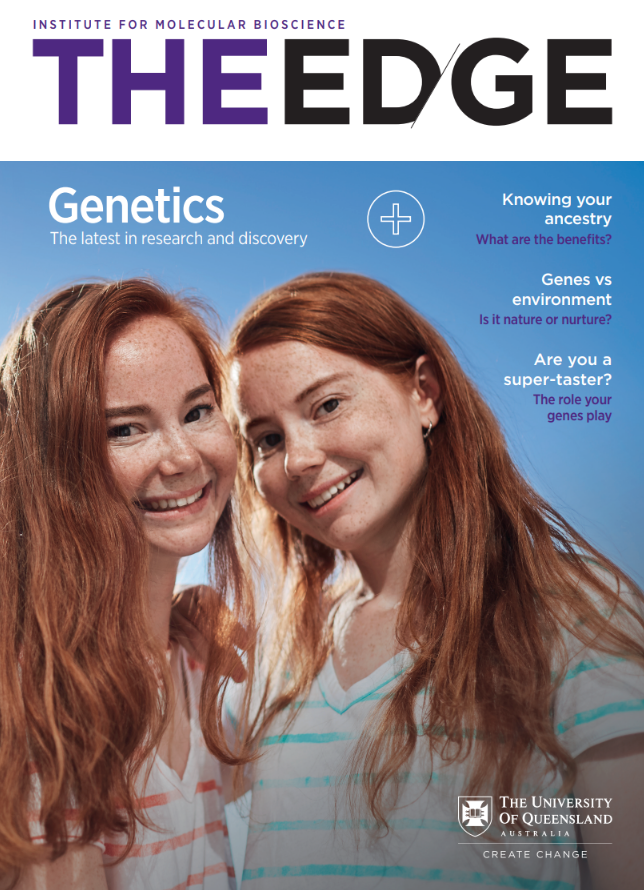


The Edge: Genetics

People have known for thousands of years that parents pass traits to their children, but it is only relatively recently that our technology has caught up to our curiosity, enabling us to delve into the mystery of how this inheritance occurs, and the implications for predicting, preventing and treating disease.

 View online
 Download magazine

Subscribe to our newsletter

Get the latest research straight to your inbox. 
Stay up-to-date as we answer questions about hot topics, and share the latest news at IMB, Australia’s #1 research institute.

Subscribe

General enquiries

  +61 7 3346 2222
  imb@imb.uq.edu.au

Media enquiries

IMB fully supports UQ's Reconciliation Action Plan and is implementing actions within our institute.
Support us

Donate to research
100% of donations go to the cause