
IMB's latest news, explainers and more


Supporting life-saving research at CCRG

Read more

Get the latest research to your inbox

Subscribe
 

  • Neavin Group

    Group Leader

    Dr Drew Neavin

    Senior Research Fellow & Group Leader
    Institute for Molecular Bioscience
    Researcher profile is public: 
    1
    Supervisor: 
    Researcher biography: 

    Dr Drew Neavin is an NHMRC Early Leadership Fellow and the Group Leader of the Context-dependent Genetics Lab at the University of Queensland Institute for Molecular Bioscience.

    Drew integrates statistical genetics with stem cell platforms and single-cell technologies to expand our understanding of genetic regulation across different contexts. She helped establish "village-in-a-dish" stem cell systems that enable high-throughput stem cell culture while reducing technical variability by co-culturing induced pluripotent stem cell lines from hundreds of individuals in a single cell culture dish. She applies this system along with other experimental models to study genetic regulation. She works across multiple disease systems with focuses in neuopsychiatric and cardiac, with a special focus on genetic modulation of drug response. She is keen to build large-scale resources that enable population genetics interrogation that consider diversity across multiple different axes.

    Researchers

    Mr Benjamin Wu-Yang Khoo

    Casual Senior Research Assistant
    Institute for Molecular Bioscience
    Researcher profile is public: 
    0
    Supervisor: 

    Students

    Ms Kate Topsfield

    Student
    Institute for Molecular Bioscience
    Researcher profile is public: 
    1
    Supervisor: 
  • Lewis Group

    Group Leader

    Emeritus Professor Richard Lewis

    Emeritus Professor
    Institute for Molecular Bioscience
    Researcher profile is public: 
    0
    Supervisor: 
    Body: 

    Highlights

    A fascination for chemistry, marine biology and zoology led Professor Richard Lewis to become expert in analyzing and characterizing venoms. He is best known for using mass spectroscopy and novel bioassays to characterise conotoxins, which are small venom peptides from predatory marine snails, and using molecular pharmacology to enhance molecules for drug development.

    The focus of Professor Lewis’s research is discovering and developing new treatments for chronic pain. Several conotoxins discovered by his research team have been taken into the clinic, including Xen2174 for severe pain.

    The potential to change people’s lives is a key motivator for Professor Lewis. By making discoveries on the scientific frontier, he hopes to change the landscape for further research, and whenever possible help deliver better treatments for chronic pain sufferers.

    Professor Lewis is Director of IMB’s Centre for Pain Research, and leader of a Program Grant in Pain Research from the NHMRC.

    Connect

    ResearcherIDScopusOrcidGoogle Scholar


    Researchers

    Students

  • PhD student
    Institute for Molecular Bioscience
  • Masters Student
    Institute for Molecular Bioscience
  • PhD student
    Institute for Molecular Bioscience

Pages

Strawberry DNA extraction activity

Extract and view DNA from a strawberry using common household ingredients.

Get started
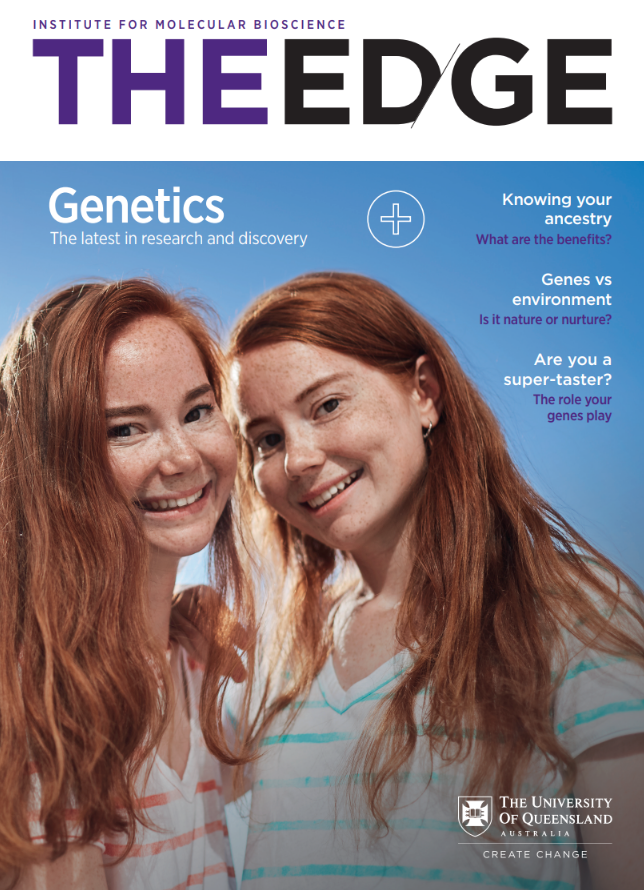


The Edge: Genetics

People have known for thousands of years that parents pass traits to their children, but it is only relatively recently that our technology has caught up to our curiosity, enabling us to delve into the mystery of how this inheritance occurs, and the implications for predicting, preventing and treating disease.

 View online
 Download magazine

Subscribe to our newsletter

Get the latest research straight to your inbox. 
Stay up-to-date as we answer questions about hot topics, and share the latest news at IMB, Australia’s #1 research institute.

Subscribe

General enquiries

  +61 7 3346 2222
  imb@imb.uq.edu.au

Media enquiries

IMB fully supports UQ's Reconciliation Action Plan and is implementing actions within our institute.

Support us

Donate to research
100% of donations go to the cause