
Get the latest research to your inbox
- PhD StudentInstitute for Molecular Bioscience
- StudentInstitute for Molecular Bioscience
- Professor Glenn King is using the world's largest collection of venoms to hunt for treatments to three pervasive nervous system disorders: chronic pain, epilepsy and stroke, as well as new eco-friendly insecticides.
- Chair, Translation Sub-Committee & Member, Advisory BoardInstitute for Molecular Bioscience
- From the science lab to the kitchen, Cameron Votan has mastered the art of experimentation, only now, he’s mixing flavours instead of formulas.
Fraser Group Team
Group Leader
Researchers
Associate Professor Jacky Suen
Senior Principal Research FellowInstitute for Molecular BioscienceResearcher profile is public:1Supervisor:Researcher biography:Critical Care Medicine focuses on supporting patients, often with one or multiple organ failures. Based at the largest Australian cardiac hospital, our research investigates better ways to support patients with heart and/or lung failure. We explore technological, pharmacological and engineering advances that could help our patients to live longer and better. Our group is world-renowned for clinically relevant large animal models, including heart failure, respiratory failure (ARDS), heart transplantation, sepsis, cardiogenic shock, and more. All our studies use hospital-grade equipment and follow the same clinical guideline to maximise translation. We actively take on honours, MPhil and PhD students from multi-disciplinary backgrounds (science, engineering, medicine, allied health), with a successful track record in supporting our students to secure their own grants and funding. Students are expected to contribute to other studies of the group. For more information about the group, please visit ccrg.org.au, and email if you are interested to join us.
Dr Jessica Benitez Mendieta
Postdoctoral Research FellowInstitute for Molecular BioscienceResearcher profile is public:1Supervisor:Dr Sandra Parker
Postdoctoral Research FellowInstitute for Molecular BioscienceResearcher profile is public:1Supervisor:Dr Alice Harford
Postdoctoral Research FellowInstitute for Molecular BioscienceResearcher profile is public:1Supervisor:Dr Eric Wu
Research FellowInstitute for Molecular BioscienceResearcher profile is public:1Supervisor:Researcher biography:Research interests in Artificial Heart and Lung therapies.
Charted Engineering (Biomedical) with Engineers Australia and BPEQ. Industry experience in nonclinical device testing and regulatory submissions of total artificial heart.
Engineering Lead at Innovative Cardiovascular Engineering and Technology Laboratory (ICETLab), Critical Care Research Group, The Prince Charles Hospital
Dr Jules Devaux
Researcher profile is public:1Supervisor:Researcher biography:I am a Research Fellow at The University of Queensland, working within the Cardiovascular and Critical Care Research Group (CCRG). My work focuses on mitochondrial function and dysfunction in clinically relevant settings, with an emphasis on improving organ preservation, transplantation outcomes, and critical-care interventions. This includes mitochondrial transplantation, ischaemia–reperfusion injury, and the development of bioenergetic markers of organ viability using high-resolution respirometry and translational physiology approaches.
Alongside, I hold a Research Fellow position in the Applied Surgery and Metabolism Laboratory (ASML) at the University of Auckland, where my research focuses on comparative mitochondrial physiology. I investigate how animals, including sharks, fishes and insects, maintain mitochondrial performance under extreme conditions such as hypoxia, thermal stress, and acidosis. These natural adaptations serve as bio-inspiration for emerging biomedical applications.
I also collaborate with the Cawthron Institute, where I assess mitochondrial health and stress resilience in aquaculture species, contributing to the development of tools for improving organismal performance under environmental change. This work supports the advancement of sustainable aquaculture and climate-resilience strategies.
Across these institutions, my goal is to integrate comparative biology, translational physiology, and bioenergetics to generate clinically and environmentally meaningful insights—linking evolutionary adaptations with innovation in human health and ecological resilience.
Dr Francesco Baccoli
Visiting AcademicInstitute for Molecular BioscienceResearcher profile is public:0Supervisor:Dr Johannes Bösch
Honorary FellowInstitute for Molecular BioscienceResearcher profile is public:0Supervisor:Dr Adrian Goldsworthy
Visiting AcademicInstitute for Molecular BioscienceResearcher profile is public:0Supervisor:Dr Yudai Iwasaki
Visiting AcademicInstitute for Molecular BioscienceResearcher profile is public:0Supervisor:Dr Haruka Matsumoto
Honorary FellowInstitute for Molecular BioscienceResearcher profile is public:1Supervisor:Dr Quentin Eric Jonathan Moyon
Honorary FellowInstitute for Molecular BioscienceResearcher profile is public:0Supervisor:Ms Dana Lee
Senior Research Assistant - Critical Care Research GroupInstitute for Molecular BioscienceResearcher profile is public:0Supervisor:Miss Rachana Panduru
Senior Research AssistantInstitute for Molecular BioscienceResearcher profile is public:0Supervisor:Dr Gabriella Abbate
Senior Research Assistant & PRIMELab ManagerInstitute for Molecular BioscienceResearcher profile is public:0Supervisor:Honorary Professor David McGiffin
Honorary ProfessorInstitute for Molecular BioscienceResearcher profile is public:0Supervisor:Dr Hideaki Nonaka
Researcher profile is public:0Supervisor:- PhD studentInstitute for Molecular Bioscience
Wainwright Group
Group Leader
Professor Brandon Wainwright
Group Leader, Genomics of Development and Disease DivisionAffiliate Professor of Institute for Molecular BioscienceInstitute for Molecular BioscienceResearcher profile is public:1Supervisor:Researcher biography:Professor Brandon Wainwright AM is Co-Director of the Children's Brain Cancer Centre and leads a laboratory within the UQ Diamantina Institute focused on understanding the genetic pathways behind medulloblastoma, a type of brain tumour that occurs predominantly in children. He is Chair of the European Molecular Biology Laboratory (EMBL) Australia, Chair of the Advisory Board of the Robinson Research Institute and Chair of the Board of the South Australian Immunogenomics Cancer Institute (SAIGENCI), and serves on the boards the Australian Genome Research Facility as well as several national and international scientific review committees, including the MRFF Brain Tumour Roadmap Committee.
Professor Wainwright completed his undergraduate and postgraduate studies at The University of Adelaide, after which he secured a postdoctoral fellowship with St Mary's Hospital at Imperial College London. During his six years at Imperial he worked on the first human genome project and also became a Medical Research Council Senior Research Fellow. He returned to Australia in 1990 to join UQ's Centre for Molecular and Cellular Biology (now IMB) and led the Institute for Molecular Biology until 2019.
Professor Wainwright is a geneticist, renowned for discovering the genetic pathway that causes most human cancer. He is skilled in molecular genetics, where he is using genetic approaches to dig through DNA and find the genes that cause disease. He commenced using these skills to locate the cystic fibrosis gene, but it was when isolating a gene responsible for a rare form of brain cancer called Medulloblastoma, that he discovered the role of the 'Hedgehog Pathway' in common human cancer.
Body:Highlights
Professor Brandon Wainwright AM is a geneticist, renowned for discovering the genetic pathway that causes most human cancer. He is skilled in molecular genetics, where he is using genetic approaches to dig through DNA and find the genes that cause disease.
He commenced using these skills to locate the cystic fibrosis gene, but it was when isolating a gene responsible for a rare form of brain cancer called Medulloblastoma, that he discovered the ‘Hedgehog Pathway.'
He discovered not only the first brain cancer-causing gene but also a pathway involved in most cancers of all types.
The primary focus of his current research is brain cancer because it is the most common cause of death in children and the most common cause of cancer-related death in people under 40. He is also applying his expertise to common cancer generally (particularly skin cancer), and neurodegenerative disease.
Success for Professor Wainwright will be seeing a child cured of brain cancer that would otherwise have died. And he is confident that he can help make it happen.
He is formerly Director of UQ's Institute for Molecular Bioscience, where he proudly leads a team of talented discovery scientists translating their findings to life-changing applications.
Connect


Researchers
Dr Laura Genovesi
Researcher profile is public:1Supervisor:Researcher biography:Laura Genovesi is a Cure Brain Cancer Foundation Research Fellow within the Paediatric Brain Cancer Laboratory headed by Professor Brandon Wainwright.
Dr Genovesi is a cancer biologist specialising in in vivo pre-clinical models to dissect the mechanisms underpinning growth of medulloblastoma, a paediatric brain tumour. They were awarded their PhD in 2012 (University of Western Australia), where they studied the role of microRNAs in the transformation of human neural stem cells to Medulloblastoma. They relocated to the University of Queensland to commence her post-doctoral studies in the laboratory of Prof. Brandon Wainwright. Dr Genovesi's post-doctoral research focuses on discovering and targeting the genetic networks that drive medulloblastoma. Their work has contributed to defining regulatory networks underlying the growth of medulloblastoma and the therapeutic application of CDK4/6 inhibitors in the treatment of medulloblastoma. Most recently, her work has characterised the status of the blood brain barrier in some of the most widely used patient derived orthotopic xenograft models of medulloblastoma. Dr Laura Genovesi's research is now focused on understanding the intrinsic and adaptive plasticity of tumour cells and acellular components of the brain tumour microenvironment (TME) that drive tumour progression and determine response to therapy. Their research integrates integrates diverse preclinical model systems including patient-derived in vivo models and dynamic ex vivo 3D hydrogel models with innovative spatial transcriptomics/ imaging and advanced computational cancer biology aiming to ultimately to improve the lives of children diagnosed with brain tumours.
Students
Dr Pengxiang Ji
Higher degree by research (PhD) studentInstitute for Molecular BioscienceResearcher profile is public:0Supervisor:Mr James Fraser
Higher degree by research (PhD) studentInstitute for Molecular BioscienceResearcher profile is public:1Supervisor:
Pages
Strawberry DNA extraction activity
Extract and view DNA from a strawberry using common household ingredients.
Get started
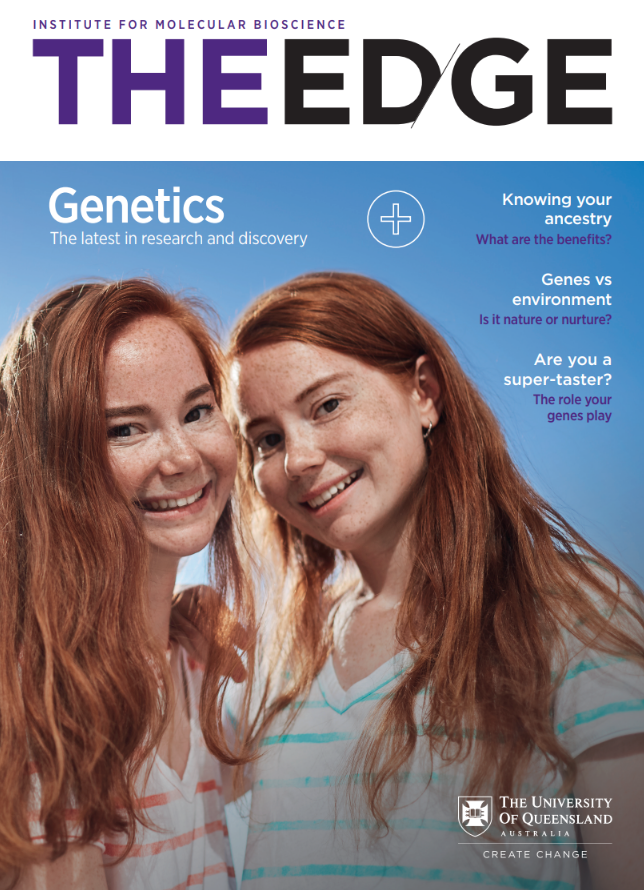
The Edge: Genetics
People have known for thousands of years that parents pass traits to their children, but it is only relatively recently that our technology has caught up to our curiosity, enabling us to delve into the mystery of how this inheritance occurs, and the implications for predicting, preventing and treating disease.
Subscribe to our newsletter
Get the latest research straight to your inbox.
Stay up-to-date as we answer questions about hot topics, and share the latest news at IMB, Australia’s #1 research institute.
General enquiries
+61 7 3346 2222
imb@imb.uq.edu.au
Media enquiries
IMB fully supports UQ's Reconciliation Action Plan and is implementing actions within our institute.
Support us
Donate to research
100% of donations go to the cause


